


English


Paperback
₹3264
(All inclusive*)
Delivery Options
Please enter pincode to check delivery time.
*COD & Shipping Charges may apply on certain items.
Review final details at checkout.
Looking to place a bulk order? SUBMIT DETAILS
Delivery Options
Please enter pincode to check delivery time.
*COD & Shipping Charges may apply on certain items.
Review final details at checkout.
About The Book
Description
Author
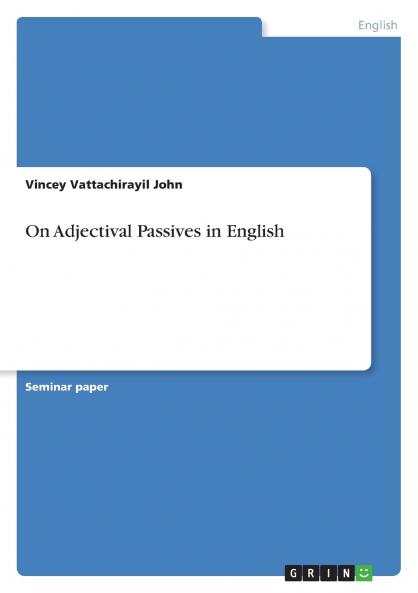
Seminar paper from the year 2010 in the subject English Language and Literature Studies - Linguistics grade: 30 University of Wuppertal language: English abstract: There have been various discussions on verbal passives and adjectival passive constructions. Adjectival passives always have stative interpretations whereas verbal passives can either have a dynamic or a stative interpretation. The question is whether adjectival passive constructions are supposed to be a type of passive constructions or merely passives in a derivative sense (cf. Huddleston and Pullum 2002: 1436f). Before researching the differences between the both passive constructions the main characterization of passive in general should be made clear. Åfarli (1992: 8) provides a brief summary of it:[...] every sentence one might reasonably want to call a passive may be minimally characterized as follows:(22) a. Relative to its active counterpart the passive sentence is marked with special verb morphology. b. The subject of the active sentence never remains subject in the passive counterpart. This statement is also supported by Emonds (2006: 17) who comments that the stress is laid on the role of the subject phrase and its relation to passive morphology. According to this characterization of passives it could be asserted that adjectival passives are only a part of a verbal passive construction. Except it can be proven that adjectives and verbal participles can be distinguished. Emonds (2006: 20) suggests a formula to distinguish between verbal and adjectival passives:a. In adjectival passives the head [A-en] is present in both LF and PF.b. In verbal passives [A-en] is absent in LF and present only in PF. The suffix -en refers to the simple past in English but it is also the given form for adjectives which leads to the ambiguity between verbal passives and adjectival passives. The LF however helps us to understand whether a passive has an ongoing (dynamic) or a complete

Piracy-free

Assured Quality

Secure Transactions

Fast Delivery

Sustainably Printed
Details
ISBN 13
9783640836024
Publication Date
-19-02-2011
Pages
-26
Weight
-46 grams
Dimensions
-148x210x2.04 mm
