

English


Paperback
₹1687
₹1849
8.76% OFF
(All inclusive*)
Delivery Options
Please enter pincode to check delivery time.
*COD & Shipping Charges may apply on certain items.
Review final details at checkout.
Looking to place a bulk order? SUBMIT DETAILS
Delivery Options
Please enter pincode to check delivery time.
*COD & Shipping Charges may apply on certain items.
Review final details at checkout.
About The Book
Description
Author
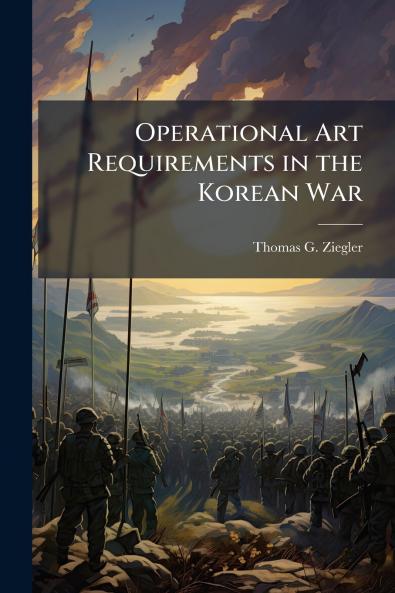
<p>Historical examples are an expedient way to develop an understanding of operational art theory and concepts. A historical illustration of both operational success and failure is the Korean War. Several aspects of the Korean War remain relevant to operational art in contemporary conflicts. It had a complex and evolving strategy a dramatic interplay of tactical success and failures uncertainty and miscalculation shortages of means to accomplish ends and the difficult challenge to set the conditions for a satisfactory conclusion to the conflict. America's full-scale involvement in the Korean War began on 25 June 1950 when the North Korean People's Army (NKPA) invaded the south intent on reunifying the country through force of arms. In little more than a month aided by the element of surprise and superiority in almost every category of military performance the NKPA captured nearly ninety percent of the Korean Peninsula. MacArthur's conceptualization and execution of Operation CHROMITE was a brilliant example of operational art. The amphibious assault at Inchon and subsequent breakout of the Pusan Perimeter by Eighth Army achieved the strategic objective--the preservation of the Republic of Korea. Then after a hasty reassessment of strategic priorities MacArthur led the U.N. forces in a disastrous attack into North Korea. During this period operational art requirements were absent and communist China intervened in the conflict. U.N. forces were nearly defeated. After a withdrawal from North Korea U.N. forces were able to reorient and stabilize the conflict primarily due to the superb leadership and vision of General Matthew Ridgway. An examination of three distinct operational periods in the Korean War using the requirements of operational art as described in Army Doctrinal Publication 3-0 Unified Land Operations will reveal whether operational art was a factor in success or failure. This monograph argues that the commander met the requirements for operation</p><p>This work has been selected by scholars as being culturally important and is part of the knowledge base of civilization as we know it. This work was reproduced from the original artifact and remains as true to the original work as possible. Therefore you will see the original copyright references library stamps (as most of these works have been housed in our most important libraries around the world) and other notations in the work.</p><p>This work is in the public domain in the United States of America and possibly other nations. Within the United States you may freely copy and distribute this work as no entity (individual or corporate) has a copyright on the body of the work.</p><p>As a reproduction of a historical artifact this work may contain missing or blurred pages poor pictures errant marks etc. Scholars believe and we concur that this work is important enough to be preserved reproduced and made generally available to the public. We appreciate your support of the preservation process and thank you for being an important part of keeping this knowledge alive and relevant.</p>

Piracy-free

Assured Quality

Secure Transactions

Fast Delivery

Sustainably Printed
Details
ISBN 13
9781288295289
Publication Date
-13-11-2012
Pages
-58
Weight
-98 grams
Dimensions
-156x234x3.16 mm
