


English



Paperback
₹1707
₹1850
7.73% OFF
(All inclusive*)
Delivery Options
Please enter pincode to check delivery time.
*COD & Shipping Charges may apply on certain items.
Review final details at checkout.
Looking to place a bulk order? SUBMIT DETAILS

Piracy-free

Assured Quality

Secure Transactions
About The Book
Description
Author
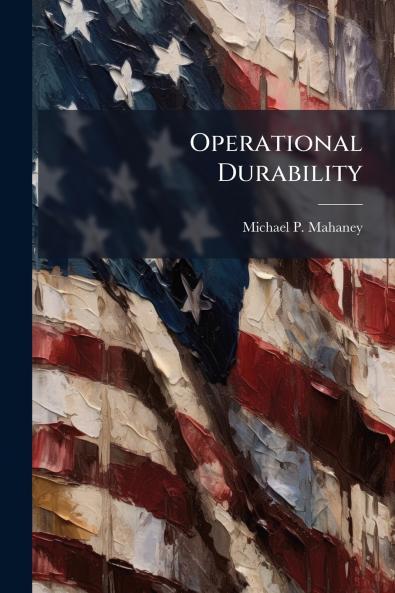
<p>Current and proposed U.S. Marine Corps doctrine proclaims the many virtues of the Marines as an expeditionary force in readiness. As America's 911 force the Marine Corps is tasked to be the military force most ready when the nation is least ready. A Ground Combat Element (GCE) combined with an organic Aviation Combat Element (ACE) and a Combat Service Support Element (CSSE) provides a potent military force rapidly deployable anywhere in the world. Capable of operating at the tactical and operational levels of war the Marine Corps undoubtedly contributes significantly to the total force projection capability of the United States. Operating independently however the ability of the Marines to project combat power over time space and depth may be limited. The nation maintains a requirement for an operationally durable force. Operational durability is the sustainability of an operational force throughout the entire depth and breadth of the theater of operations for an indefinite period of time. Operational durability consists of four elements. These are time depth and breadth sustainability and the moral and material forces of a country. By analyzing the structure doctrine (current and proposed) and the requirements that the nation has placed on the Marine Corps against operational durability criteria a determination can be made as to whether or not the Marine Corps is an operationally durable force. This analysis concludes that both in current and proposed doctrine the MEU (SOC) and the MEB are arguably not operationally durable. Under current and proposed doctrine the MEF is operationally durable. The results of this monograph have applicability to the development of the U.S. Army's Interim Brigade Combat Team (IBCT) concept. As a rapidly deploying force the IBCT presents a formidable flexible force that is tactically significant. But is the IBCT operationally durable?</p><p>This work has been selected by scholars as being culturally important and is part of the knowledge base of civilization as we know it. This work was reproduced from the original artifact and remains as true to the original work as possible. Therefore you will see the original copyright references library stamps (as most of these works have been housed in our most important libraries around the world) and other notations in the work.</p><p>This work is in the public domain in the United States of America and possibly other nations. Within the United States you may freely copy and distribute this work as no entity (individual or corporate) has a copyright on the body of the work.</p><p>As a reproduction of a historical artifact this work may contain missing or blurred pages poor pictures errant marks etc. Scholars believe and we concur that this work is important enough to be preserved reproduced and made generally available to the public. We appreciate your support of the preservation process and thank you for being an important part of keeping this knowledge alive and relevant.</p>
Piracy-free
Assured Quality
Secure Transactions
Delivery Options
Please enter pincode to check delivery time.
*COD & Shipping Charges may apply on certain items.
Review final details at checkout.
Details
ISBN 13
9781288295531
Publication Date
-13-11-2012
Pages
-60
Weight
-100 grams
Dimensions
-156x234x3.26 mm
