


English
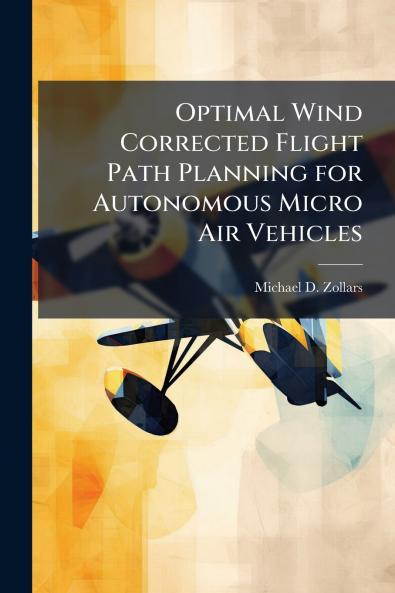



Paperback
₹1828
₹2109
13.32% OFF
(All inclusive*)
Delivery Options
Please enter pincode to check delivery time.
*COD & Shipping Charges may apply on certain items.
Review final details at checkout.
Looking to place a bulk order? SUBMIT DETAILS
Delivery Options
Please enter pincode to check delivery time.
*COD & Shipping Charges may apply on certain items.
Review final details at checkout.
About The Book
Description
Author
<p>This research effort focuses on determining the optimal flight path required to put a micro air vehicle's (MAVs) fixed sensor on a target in the presence of a constant wind. Autonomous flight is quickly becoming the future of air power and over the past several years the size and weight of autonomous vehicles has decreased dramatically. As these vehicles were implemented into the field it was quickly discovered that their flight paths are severely altered by wind. However since the size of the vehicle does not allow for a gimbaled camera only a slight perturbation to the attitude of the vehicle will cause the sensor footprint to be displaced dramatically. Therefore the goal of this research was to use dynamic optimization techniques to determine the optimal flight path to place a MAV's sensor footprint on a target when operating in wind for three different scenarios. The first scenario considered the minimum time path given an initial position and heading and a final position and heading. The second scenario minimized the error between the MAV's ground track and a straight line to the target in order to force a desired path on the vehicle. The final scenario utilized both a forward mounted sensor as well as a side mounted sensor to optimize the time the target is continually in view of the sensor footprint. Each of these scenarios has been captured in simulated plots that depict varying wind angles wind speeds and initial and final heading angles. These optimal flight paths provide a benchmark that will validate the quality of future closed-loop wind compensation control systems.</p><p>This work has been selected by scholars as being culturally important and is part of the knowledge base of civilization as we know it. This work was reproduced from the original artifact and remains as true to the original work as possible. Therefore you will see the original copyright references library stamps (as most of these works have been housed in our most important libraries around the world) and other notations in the work.</p><p>This work is in the public domain in the United States of America and possibly other nations. Within the United States you may freely copy and distribute this work as no entity (individual or corporate) has a copyright on the body of the work.</p><p>As a reproduction of a historical artifact this work may contain missing or blurred pages poor pictures errant marks etc. Scholars believe and we concur that this work is important enough to be preserved reproduced and made generally available to the public. We appreciate your support of the preservation process and thank you for being an important part of keeping this knowledge alive and relevant.</p>

Piracy-free

Assured Quality

Secure Transactions

Fast Delivery

Sustainably Printed
Details
ISBN 13
9781288307890
Publication Date
-16-11-2012
Pages
-120
Weight
-183 grams
Dimensions
-156x234x6.57 mm
