


English


₹5772
(All inclusive*)
Paperback
Delivery Options
Please enter pincode to check delivery time.
*COD & Shipping Charges may apply on certain items.
Review final details at checkout.
Looking to place a bulk order? SUBMIT DETAILS
Delivery Options
Please enter pincode to check delivery time.
*COD & Shipping Charges may apply on certain items.
Review final details at checkout.
About The Book
Description
Author
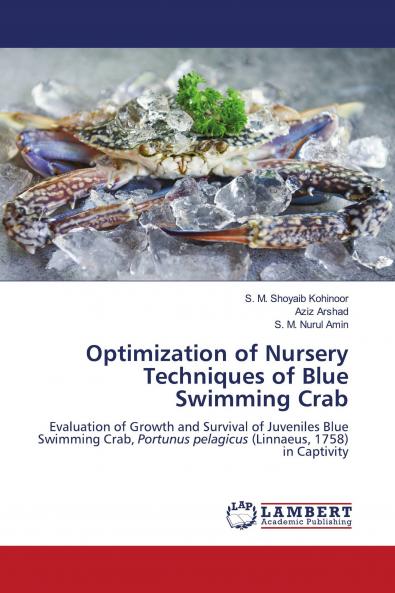
Growth and survival of Portunus pelagicus juveniles in captivity were investigated with different bottom substrates feeds and stocking density. The highest survival of the juveniles at 65.33% was achieved (P <0.05) using sandy substrates followed by soil (29.33%) sand + soil (28.00%) and control (21.33%). Water quality parameters were overall better in RAS with a significantly (P <0.05) lower level of ammonia-N (0.04 ± 0.10 mg/L) and nitrite-N (0.02 ± 0.07 mg/L). The crabs fed with squid showed significantly (P <0.05) higher carapace width (68.02 ± 3.51 mm) than those fed the scad fish (53.69 ± 3.32 mm) and Acetes shrimps (51.19 ± 3.76 mm). Feeding three times per day exhibited the highest carapace width (65.23 ± 1.61 mm) and survival (50.03 ± 0.02%) of P. pelagicus juveniles. The highest percentage of survival (58.33 ± 0.02%) was observed at 16 individuals / m2 whereas the lowest was found at 28 individuals / m2 (33.36 ± 2.62%) in different stocking densities experiment. Therefore the practice of mixed feeds feeding frequency of three times per day and 16 individuals / m2 stocking density is recommended for juvenile culture of blue swimming crab

Piracy-free

Assured Quality

Secure Transactions

Fast Delivery

Sustainably Printed
Details
ISBN 13
9786202554374
Publication Date
-12-06-2020
Pages
-104
Weight
-153 grams
Dimensions
-150x220x5.94 mm
