

English



₹18781
₹21165
11.26% OFF
(All inclusive*)
Hardback
Delivery Options
Please enter pincode to check delivery time.
*COD & Shipping Charges may apply on certain items.
Review final details at checkout.
Looking to place a bulk order? SUBMIT DETAILS
Delivery Options
Please enter pincode to check delivery time.
*COD & Shipping Charges may apply on certain items.
Review final details at checkout.
About The Book
Description
Author
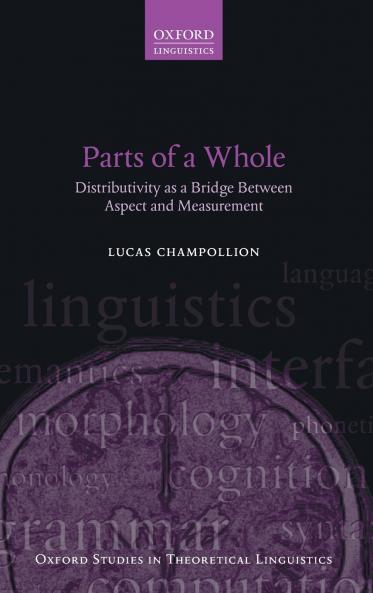
This book uses mathematical models of language to explain why there are certain gaps in language: things that we might expect to be able to say but can't. For instance why can we say I ran for five minutes but not *I ran all the way to the store for five minutes? Why is <em>five pounds of books</em> acceptable but *<em>five pounds of book </em>not acceptable? What prevents us from saying *<em>sixty degrees of water</em> to express the temperature of the water in a swimming pool when <em>sixty inches of water </em>can express its depth? And why can we not say *<em>all the ants in my kitchen are numerous</em>? The constraints on these constructions involve concepts that are generally studied separately: aspect plural and mass reference measurement and distributivity. In this book Lucas Champollion provides a unified perspective on these domains connects them formally within the framework of algebraic semantics and mereology and uses this connection to transfer insights across unrelated bodies of literature and formulate a single constraint that explains each of the judgments above.<br>

Piracy-free

Assured Quality

Secure Transactions

Fast Delivery

Sustainably Printed
Details
ISBN 13
9780198755128
Publication Date
-01-05-2017
Pages
-332
Weight
-565 grams
Dimensions
-156x234x19.05 mm
