
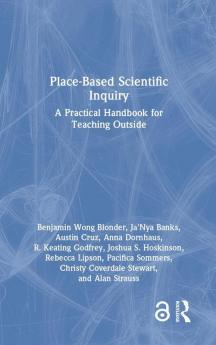

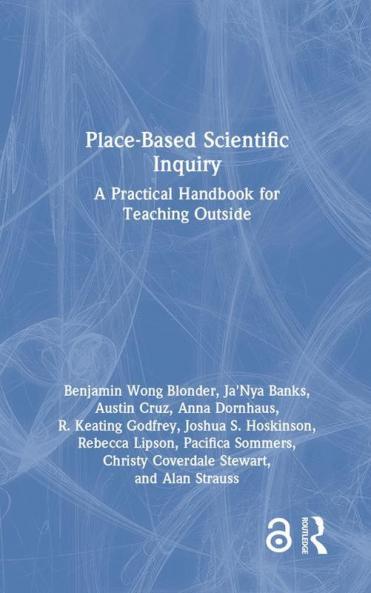
About The Book

<p>Learn how to facilitate scientific inquiry projects by getting out of the classroom and connecting to the natural environment—in your schoolyard, or in your community!</p><p>Providing a contemporary perspective on how to do scientific inquiry in ways that can make teachers’ lives easier and students’ experiences better, this book draws on authentic inquiry, engaging with communities, and teaching through project-based learning to help students design and carry out scientific inquiry projects that are grounded in their local places. This accessible guide will help you to develop skills around facilitation, team building, and learning outdoors in schoolyards and parks, acting as a go-to toolkit for teachers to help build confidence and skills in these areas. </p><p>Written according to the Next Generation Science Standards, this book supports teachers in fostering community engagement and a justice-first classroom. The approachable resources included in this book will help teachers with all levels of experience succeed in empowering students grades 3–12 in their science learning.</p><p>Additional support materials including template documents for student use and for teacher planning, as well as examples of real student work, are available online at www.routledge.com/9781032434155.</p><p>The Open Access version of this book, available at www.taylorfrancis.com, has been made available under a Creative Commons Attribution (CC-BY) 4.0 license</p> <p>1. Introduction</p><p>1.1. A desert story</p><p>1.2. How to use the book</p><p>2. Guiding concepts</p><p>2.1. Justice-first science teaching</p><p>2.2. Place-based teaching</p><p>2.3. Inquiry-based teaching</p><p>2.4. Outdoor teaching</p><p>2.5. Centering student identity</p><p>2.6. Meeting the Next Generation Science Standards (NGSS)</p><p>2.7. Learning beyond the NGSS</p><p>2.8. Decolonizing teaching</p><p>2.9. Linking to Indigenous science</p><p>3. Setting scope and expectations</p><p>3.1. Your role as teacher</p><p>3.2. Choosing a topic</p><p>3.3. Scheduling and time considerations</p><p>3.4. Scaffolding projects into your curriculum</p><p>3.5. Cost considerations</p><p>3.6. Place considerations</p><p>3.7. Student identity considerations</p><p>3.8. Universal design, special needs, and disability</p><p>4. Acquiring resources and planning safe logistics</p><p>4.1. Partnering with volunteers</p><p>4.2. Acquiring equipment and collecting data at low cost</p><p>4.3. Safety and logistical preparation</p><p>5. Getting started via exploration and team building</p><p>5.1. Dividing students into groups</p><p>5.2. Using notebooks</p><p>5.3. Exploration, observation, and sense of place</p><p>5.4. Acquiring background information</p><p>5.5. Recognizing relationships and responsibility to place</p><p>6. Facilitating teams and resolving conflict</p><p>6.1. Small group facilitation</p><p>6.2. Setting behavioral expectations</p><p>6.3. Encouraging positive behavior from individuals</p><p>6.4. Encouraging positive behavior from groups</p><p>6.5. Team building</p><p>6.6. Team contracts and check-ins</p><p>6.7. Handling multiple groups</p><p>6.8. Getting groups back on track</p><p>7. Developing a question and study design</p><p>7.1. Facilitating question development</p><p>7.2. Building a strong question</p><p>7.3. Designing a study and using an anchor chart</p><p>7.4. Identifying multiple hypotheses and predictions, or not</p><p>8. Planning data collection</p><p>8.1. Choosing how much to measure</p><p>8.2. Choosing what to do (protocols, checklists, and datasheets)</p><p>8.3. Choosing roles</p><p>9. Collecting data outdoors</p><p>9.1. Practicing collecting data</p><p>9.2. Collecting data</p><p>9.3. Securing data</p><p>10. Analyzing and sense-making</p><p>10.1. Drawing conclusions from data</p><p>10.2. Visually interpreting results</p><p>10.3. Statistical tests</p><p>11. Reflecting and recognizing success</p><p>11.1. Reflection</p><p>11.2. Recognition</p><p>12. Sharing outcomes</p><p>12.1. How and why to share projects</p><p>12.2. Supporting presentation development</p><p>12.3. Holding a community event</p><p>13. Assessing learning</p><p>13.1. Why (or why not) to assess</p><p>13.2. Student-centered reflection and feedback</p><p>14. Conclusion</p><p>14.1. What students and teachers say</p><p>14.2. Overcoming common fears</p><p>14.3. Starting small and dreaming big</p><p>References</p>
Piracy-free
Piracy-free
Assured Quality
Assured Quality
Secure Transactions
Secure Transactions
Delivery Options
Please enter pincode to check delivery time.
*COD & Shipping Charges may apply on certain items.
Review final details at checkout.
downArrow

Details


LOOKING TO PLACE A BULK ORDER?CLICK HERE