


English


Paperback
₹4896
₹5640
13.19% OFF
(All inclusive*)
Delivery Options
Please enter pincode to check delivery time.
*COD & Shipping Charges may apply on certain items.
Review final details at checkout.
Looking to place a bulk order? SUBMIT DETAILS
Delivery Options
Please enter pincode to check delivery time.
*COD & Shipping Charges may apply on certain items.
Review final details at checkout.
About The Book
Description
Author
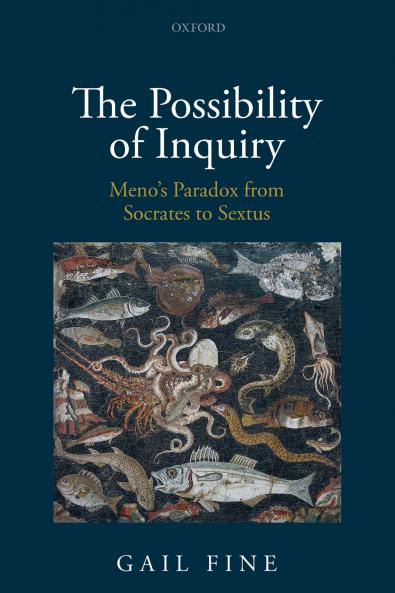
Gail Fine presents an original interpretation of a compelling puzzle in ancient philosophy. Meno's Paradox which is first formulated in Plato's <em>Meno</em> challenges the very possibility of inquiry. Plato replies with the theory of recollection according to which we all had prenatal knowledge of some range of things and what we call inquiry involves recollecting what we previously knew; he also illustrates this with his famous cross-examination of an untutored slave about a geometry problem whose solution the slave is able to discover through inquiry. Hence contrary to the paradox inquiry is possible after all. Plato is not the only philosopher to grapple with Meno's Paradox: so too do Aristotle the Epicureans the Stoics and Sextus. How do their various replies compare with one another and with Plato's? How good are any of their replies? In a fascinating fragment preserved in Damascius' <em>Commentary on the Phaedo</em> Plutarch briefly considers these questions (though for obvious chronological reasons he doesn't discuss Sextus). But Fine's book is the first full-length systematic treatment of the paradox and responses to it. Among the topics discussed are the nature of knowledge; how knowledge differs from mere true belief; the nature of inquiry; varieties of innatism; concepts and meaning; the scope and limits of experience. <em>The Possibility of Inquiry</em> will be of interest to anyone interested in ancient epistemology in ancient philosophy or in epistemology.<br>

Piracy-free

Assured Quality

Secure Transactions

Fast Delivery

Sustainably Printed
Details
ISBN 13
9780198822646
Publication Date
-01-12-2018
Pages
-414
Weight
-586 grams
Dimensions
-156x234x21.5 mm
