



This Book is Out of Stock!
English




Hardback
₹23155
(All inclusive*)
Delivery Options
*COD & Shipping Charges may apply on certain items.
Review final details at checkout.
Looking to place a bulk order? SUBMIT DETAILS

Piracy-free

Assured Quality

Secure Transactions
About The Book
Description
Author(s)
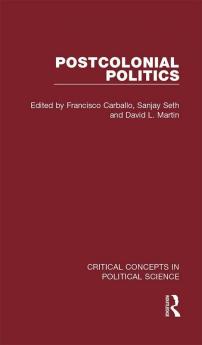
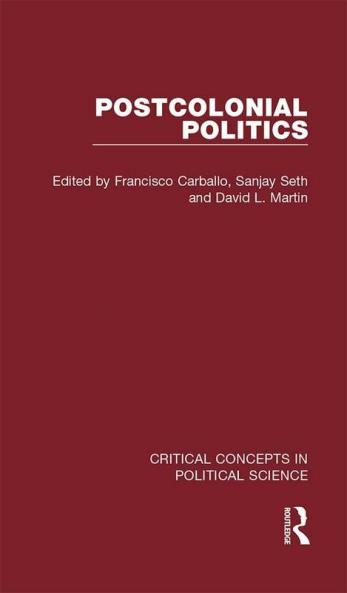
<p>This timely new four volume collection series enables users to make sense of the vast diversity of texts, generated across different continents and in different languages, and spanning numerous fields of intellectual and literary endeavour, that constitute the formative and central works of Postcolonial Politics. Fully indexed and with a new introduction, this collection will be welcomed by scholars, other researchers, and advanced students as an indispensable reference and pedagogic resource.</p> <p>Volume 2: Politics of Space and The City </p><p>Part 5. International Relations and Geopolitics </p><p>19. Sankaran Krishna, ‘Race, Amnesia, and the Education of International Relations’, <i>Alternatives: Global, Local, Political</i> 26, 4, 2001, 401–24. </p><p>20. Robbie Shilliam, ‘A Fanonian Critique of Lebow’s <i>A Cultural Theory of International Relations</i>’, <i>Millennium</i> 38, 1, 2009, 117–36. </p><p>21. Sanjay Seth, ‘Postcolonial Theory and the Critique of International Relations’, <i>Millennium</i> 40, 1, 2011, 167–83. </p><p>22. Gurminder K. Bhambra, ‘Historical Sociology, International Relations and Connected Histories’, <i>Cambridge Review of International Affairs</i> 23, 1, 2010, 127–43. </p><p>23. Ashis Nandy and Phillip Darby, ‘International Relations as Variations on Everyday Human Relations’, <i>Postcolonial Studies</i> 18, 2, 2015, 103–14. </p><p>24. Zeynep Gulsah Capan, ‘Decolonising International Relations?’, <i>Third World Quarterly</i> 38, 1, 2017, 1–15. </p><p>25. Karen Tucker, ‘Unraveling Coloniality in International Relations: Knowledge, Relationality, and Strategies for Engagement’, <i>International Political Sociology</i> 12, 3, 2018, 215–32. </p><p>Part 6. Geography and Cartography</p><p>26. James D. Sidaway, ‘Postcolonial Geographies: An Exploratory Essay’, <i>Progress in Human Geography </i>24, 4, 2000, 591–612. </p><p>27. Catherine Nash, ‘Cultural Geography: Postcolonial Cultural Geographies’, <i>Progress in Human Geography</i> 26, 2, 2002, 219–30. </p><p>28. Cheryl McEwan, ‘Material Geographies and Postcolonialism’, <i>Singapore Journal of Tropical Geography</i> 24, 3, 2003, 340–55. </p><p>29. Mary Gilmartin &amp; Lawrence D. Berg, ‘Locating Postcolonialism’, <i>Area</i> 39, 1, 2007, 120-124.</p><p>30. Jeff Oliver, ‘On Mapping and its Afterlife: Unfolding Landscapes in Northwestern North America’, <i>World Archaeology</i>, 43, 1 2011, 66-85. </p><p>31. Pat Noxolo, Parvati Raghuram and Clare Madge, ‘Unsettling Responsibility: Postcolonial Interventions’, <i>Transactions of the Institute of British Geographers</i> 37, 3, 2012, 418–29. </p><p>32. Sarah A. Radcliffe, ‘Decolonising Geographical Knowledges’, <i>Transactions of the Institute of British Geography</i> 42, 3, 2017, 329–33. </p><p>Part 7. Urban Studies </p><p>33. Arjun Appadurai, ‘Spectral Housing and Urban Cleansing: Notes on Millennial Mumbai’, <i>Public Culture</i> 12, 3, 2000, 627–51. </p><p>34. Ravi Sundaram, ‘Uncanny Networks: Pirate, Urban and New Globalisation’, <i>Economic and Political Weekly</i> 39, 1, 2004, 64–71. </p><p>35. Mona Domosh, ‘Postcolonialism and the American City’, <i>Urban Geography </i>25, 8, 2004, 742–54. </p><p>36. Eyal Weizman, ‘Evacuations: De-Colonizing Architecture’, in <i>Hollow Land: Israel’s Architecture of Occupation</i> (London: Verso Books, 2007), pp. 221–36.</p><p>37. Bill Ashcroft, ‘Urbanism, Mobility and Bombay: Reading the Postcolonial City’, <i>Journal of Postcolonial Writing</i> 47, 5, 2011, 497–509. </p><p>38. AbdouMaliq Simone, ‘A Town on Its Knees? Economic Experimentations with Postcolonial Urban Politics in Africa and Southeast Asia’, <i>Theory, Culture &amp; Society</i> 27, 7–8, 2011, 130–54. </p><p>39. Claire Chambers and Graham Huggan, ‘Reevaluating the Postcolonial City: Production, Reconstruction, Representation’, <i>Interventions </i>17, 6, 2015, 783–88. </p><p>40. Bobby Benedicto, ‘The Queer Afterlife of the Postcolonial City: (Trans)Gender Performance and the War of Beautification’, <i>Antipode </i>47, 3, 2015, 580–97. </p>
Piracy-free
Assured Quality
Secure Transactions
*COD & Shipping Charges may apply on certain items.
Review final details at checkout.
₹23155
Out Of Stock
All inclusive*
Details
ISBN 13
9781138676794
Publication Date
-08-11-2022
Pages
-396
Weight
-653 grams
Dimensions
-155.96x233.93x22.34 mm
