

English


Paperback
₹2798
₹2847
1.72% OFF
(All inclusive*)
Delivery Options
Please enter pincode to check delivery time.
*COD & Shipping Charges may apply on certain items.
Review final details at checkout.
Looking to place a bulk order? SUBMIT DETAILS
Delivery Options
Please enter pincode to check delivery time.
*COD & Shipping Charges may apply on certain items.
Review final details at checkout.
About The Book
Description
Author
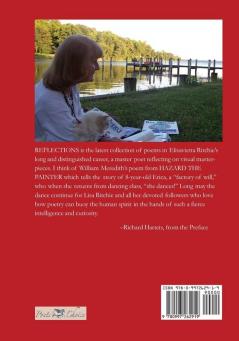
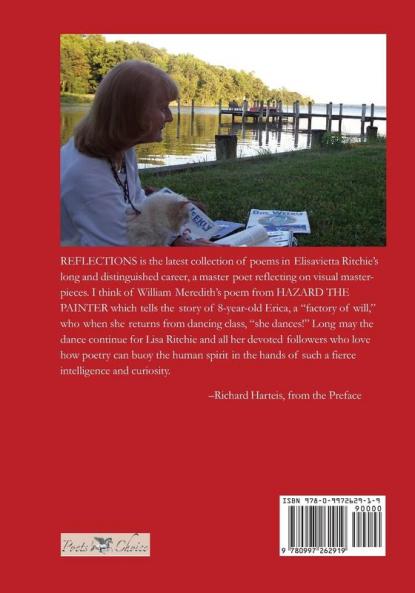
<p><strong>This will be the third collection of Elisavietta Ritchie&rsquo;s work we have been privileged to publish and what a remarkable collection it is rich imagination and a talent for metaphors the hallmarks of her work. Here we see a poet at the top of her game and game is the precise word for the often whimsical accounts she gives of the painting on which she reflects. William Meredith&rsquo;s short poem seems an apt introduction to the book. </strong></p><p>&nbsp;</p><p><strong>One thinks of Keats&rsquo; critical touchstone the concept of negative capability he proposes the sensitivity and imaginative power an artist has to intuit even the very center of a cue ball the ability of the individual to perceive think and operate outside the box. Poets often employ this symbiotic relationship with the visual arts a literary device known as ekphraksis used to convey the deeper symbolism of the corporeal art form by means of a separate medium such as poetry. The poet contemplates a work of art and responds with a lifetime of experience and curiosity to imagine the world found in a given painting.</strong></p><p>&nbsp;</p><p><strong>Here the poems are written in the voices of the artist his wife (who might also be an artist) his mistress his model his dog&mdash;One thinks of the popular film in which all the characters in the paintings in a museum step from their frames and celebrate their liberation once the museum doors have closed for the night. </strong></p><p>&nbsp;</p><p><strong>This seems a happy collaboration of artist and poet enhancing our understanding of a painting as well as taking joy in the work from a verbal prospective. &ldquo;How do I know what I think until I see what I say&rdquo; I believe W.H. Auden once quipped.</strong></p><p>&nbsp;</p><p><strong>In Chinese ideograms a symbol for house combined with the figure of a stick woman within the house may be a symbol of peace. A plus B equals C as it were when a poet creates a new work standing on the shoulders of another artist creating something new under the sun.</strong></p><p>&nbsp;</p><p><strong>An earlier</strong> <strong>title for this collection GLAD I GAVE TO ART MY ALL highlights what a long and distinguished career Lisa Ritchie has had. Perhaps only Grace Cavalieri is more prolific. When do these women sleep! I think of a William Meredith poem from HAZARD THE PAINTER which tells the story of a 8-year-old Erica a &ldquo;factory of will&rdquo; who when she returns from dancing class &ldquo;she dances!&rdquo; Long may the dance continue for Lisa Ritchie and all her devoted followers who love how poetry can buoy the human spirit in the hands of such a fierce intelligence and curiosity. </strong></p>

Piracy-free

Assured Quality

Secure Transactions

Fast Delivery

Sustainably Printed
Details
ISBN 13
9780997262919
Publication Date
-21-11-2016
Pages
-168
Weight
-308 grams
Dimensions
-178x254x11.6 mm
