




This Book is Out of Stock!
English





Hardback
₹23155
(All inclusive*)
Delivery Options
*COD & Shipping Charges may apply on certain items.
Review final details at checkout.
Looking to place a bulk order? SUBMIT DETAILS

Piracy-free

Assured Quality

Secure Transactions
About The Book
Description
Author(s)
Shoutouts
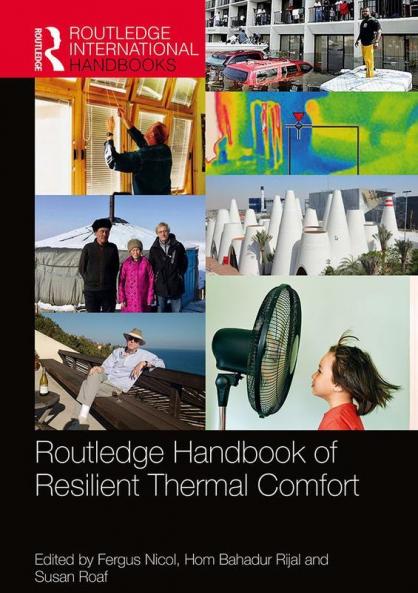
<p>This book brings together some of the finest academics in the field to address important questions around the way in which people experience their physical environments, including temperature, light, air-quality, acoustics and so forth. It is of importance not only to the comfort people feel indoors, but also the success of any building as an environment for its stated purpose. The way in which comfort is produced and perceived has a profound effect on the energy use of a building and its resilience to the increasing dangers posed by extreme weather events, and power outages caused by climate change. Research on thermal comfort is particularly important not only for the health and well-being of occupants but because energy used for temperature control is responsible for a large part of the total energy budget of the built environment. </p><p>In recent years there has been an increasing focus on the vulnerabilities of the thermal comfort system; how and why are buildings failing to provide safe and agreeable thermal environments at an affordable price? Achieving comfort in buildings is a complex subject that involves physics, behaviour, physiology, energy conservation, climate change, and of course architecture and urban design. Bringing together the related disciplines in one volume lays strong, multi-disciplinary foundations for new research and design directions for resilient 21st century architecture. This book heralds workable solutions and emerging directions for key fields in building the resilience of households, organisations and populations in a heating world.</p> <p><strong>Part I New approaches to comfort, occupants and resilience</strong> 1. The shapes of comfort and resilience <em>Fergus Nicol </em> 2.<em> </em>Rethinking resilient thermal comfort within the context of human-building resilience <em>Marcel Schweiker</em> 3<em>. </em>Why occupants need a role in building operation: A framework for resilient design <em>Lisa Heschong and Julia Day </em><strong>Part II Climate change and comfort</strong> 4. The impact of future UK heatwave to the thermal resilience in office and residential buildings – A comparison <em>Asif Din and Hala El Khorazaty </em> 5.<em> </em>Resilient design in extreme climates: 5-steps overheating assessment method for naturally ventilated buildings <em>Daniel Zepeda-Rivas, Jorge Rodríguez-Álvarez and José Roberto García-Chávez </em><strong>Part III Sleep and comfort for the old and the young<em> </em></strong>6.<strong><em> </em></strong>Summertime indoor temperatures and thermal comfort in nursing care homes in <em>London Rajat Gupta and Alastair Howard </em>7. Assessing human resilience: A study of thermal comfort, wellbeing and health of older people <em>Terence Williamson, Veronica Soebarto, Helen Bennetts, Larissa Arakawa Martins, Dino Pisaniello, Alana Hansen, Renuka Visvanathan, Andrew Carre and Joost van Hoof </em>8.<em> </em>Do children feel warmer than adults? Overheating prevention in schools in the face of climate change <em>Marije te Kulve, Runa T. Hellwig, Froukje van Dijken and Atze Boerstra </em>9. Causes and effects of partial cooling during sleep <em>Noriko Umemiya and Yuhan Chen </em><strong>Part IV Resilient design for buildings and cities </strong>10.<strong><em> </em></strong>Overheating and passive cooling strategies in low-income residential buildings in Abuja, Nigeria <em>Michael U. Adaji, Timothy O. Adekunle and Richard Watkins </em>11. The devolution of thermal resilience in residential houses in Khartoum <em>Huda Z.T. Elsherif, Marialena Nikolopoulou and Henrik Schoenefeldt </em> 12.<em> </em>Design of adaptive opportunities for people in buildings <em>Runa T. Hellwig, Despoina Teli, Marcel Schweiker, Joon-Ho Choi, M.C. Jeffrey Lee, Rodrigo Mora, Rajan Rawal, Zhaojun Wang and Farah Al-Atrash </em>13.<em> </em>Resiliency lessons of traditional living in nomadic yurts <em>Dolaana Khovalyg </em>14.<em> </em>Passive cooling strategies for low carbon architecture <em>Pablo La Roche</em> 15. Passive design for extreme heat: The Austrian pavilion at EXPO 2020 in Dubai <em>Georgios Gourlis and Peter Holzer </em>16.<em> </em>Studying outdoor thermal comfort and resilience in an urban design perspective: A case study in Ipoh old town and new town, Malaysia <em>Mei-Yee Teoh, Michihiko Shinozaki, Kei Saito and Ismail Said </em><strong>Part V Resilience and comfort in offices </strong>17. Adaptive approaches to enhancing resilient thermal comfort in Japanese offices <em>Hom B. Rijal, Michael A. Humphreys and J. Fergus Nicol </em>18. Thermal comfort and occupant disposition in mixed-mode offices in a Brazilian subtropical climate <em>Ricardo Forgiarini Rupp, Jørn Toftum and Enedir Ghisi </em>19.<em> </em>Tools and rules for behavioural agency in buildings: Minimising energy use while maintaining comfort <em>Julia K. Day </em>20.<em> </em>Mixed mode is better than air conditioned offices for resilient comfort: Adaptive behaviour and visual thermal landscaping <em>Sally Shahzad and Hom B Rijal </em>21. Effects of light and ambient temperature on visual and thermal appraisals <em>Maaike Kompier, Karin Smolders and Yvonne de Kort </em>22.<em> </em>Reaching thermal comfort zone limits for resilient building operation: A winter case study for offices <em>Dolaana Khovalyg, Verena M. Barthelmes and Arnab Chatterjee </em><strong>Part VI Indoor environmental quality, energy and life cycle analysis </strong>23.<strong> </strong>Methodology of IEQ assessment in energy efficient buildings <em>Karel Kabele, Zuzana Veverková and Miroslav Urban </em>24. Flexible future comfort <em>Sanober Hassan Khattak, Andrew Wright and Sukumar Natarajan </em> 25.<em> </em>Sight beyond reach: Dynamic life cycle assessment to support resilient retrofit decision-making in a changing climate <em>Vanessa Gomes, Marcella R. M. Saade, Leticia O. Neves, Iris Loche, Lizzie M. Pulgrossi and Maristela G. Silva </em>26.<em> </em>Indoor environmental quality, energy-efficiency and thermal comfort in the retrofitting of housing: A literature review <em>Marco Ortiz and Philomena M. Bluyssen <strong>Part VII The role of ventilation and radiation in cooling and heating </strong></em>27. Double skin buildings and resilience for commercial buildings <em>Eusébio Conceição, João Gomes, Ma Inês Conceição, Ma Manuela Lúcio and Hazim Awbi </em> 28.<em> </em>Cooling with thermally activated, radiative surfaces: Resilient answers to upcoming cooling needs, extending the application range of adaptive comfort <em>Peter Holzer and David Stuckey </em>29.<em> </em>Rethinking radiant comfort <em>Eric Teitelbaum and Forrest Meggers </em><strong>Part VIII National databases and comfort education </strong>30.<em><strong> </strong></em>Towards resilient cooling possibilities for Brazilians’ hot and humid climates: Exploring the national thermal comfort database <em>Carolina Buonocore, Renata De Vecchi, Greici Ramos, Maira Andre, Christhina Candido and Roberto Lamberts </em>31.<em> </em>Teaching comfort: Critical approaches, digital interventions and contemporary choices <em>Ola Uduku, B K Satish, Gillian Treacy and Yiqianq Zhao </em><strong>Part IX COVID-19: transmission and trust <em> </em></strong>32.<em><strong> </strong></em>How airborne transmission of SARS-CoV-2 confirmed the need for new ways of proper ventilation <em>Philomena M. Bluyssen </em>33.<em> </em>COVID-19: Trust, windows and the psychology of resilience <em>Susan Roaf </em><strong>Part X The past, and future of comfort standards <em> </em></strong>34.<strong><em> </em></strong>Resilient comfort standards <i>Susan Roaf and Fergus Nicol </i>Index</p>
Piracy-free
Assured Quality
Secure Transactions
*COD & Shipping Charges may apply on certain items.
Review final details at checkout.
₹23155
Out Of Stock
All inclusive*
Details
ISBN 13
9781032155975
Publication Date
-19-04-2022
Pages
-654
Weight
-1180 grams
Dimensions
-174x246x35.6 mm
