

Sanskrit


Hardback
₹1920
(All inclusive*)
Delivery Options
Please enter pincode to check delivery time.
*COD & Shipping Charges may apply on certain items.
Review final details at checkout.
Looking to place a bulk order? SUBMIT DETAILS
Delivery Options
Please enter pincode to check delivery time.
*COD & Shipping Charges may apply on certain items.
Review final details at checkout.
About The Book
Description
Author
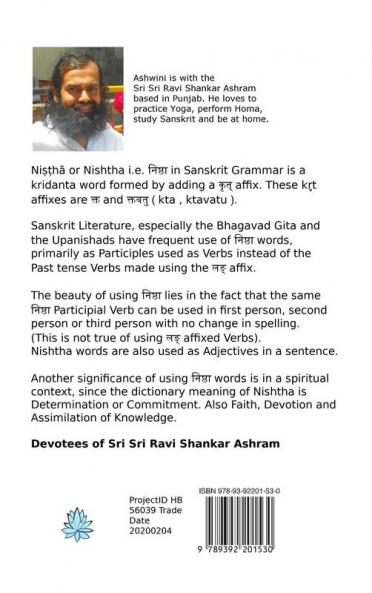
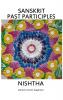
<p><span style=color: rgba(51 51 51 1)>Niṣṭhā or Nishtha i.e. निष्ठा in Sanskrit Grammar is a kridanta word formed by adding a कृत् affix. These kr̥t&nbsp;affixes are क्त and क्तवतु (kta ktavatu). </span>Sanskrit Literature especially the&nbsp;<u>Bhagavad Gita and the Upanishads</u>&nbsp;have frequent use of निष्ठा words&nbsp;primarily as Participles used as Verbs. And that too the Past Participle Passive क्त (kta) used in the sense of&nbsp;Past Tense in place of the Verbs made using the लङ् affix.&nbsp;</p><p><br></p><p><strong>The beauty of using निष्ठा lies in the fact that the same निष्ठा Participial Verb can be used in first person second&nbsp;person or third person with no change in spelling.</strong>&nbsp;(This is not true of using लङ् affixed Verbs).</p><p><br></p><p>Nishtha words are also used as Adjectives in a sentence. Another significance of using निष्ठा words is in a&nbsp;<strong>spiritual context</strong> since the dictionary meaning of Nishtha is&nbsp;Determination or Commitment. Also Faith Devotion and Assimilation of Knowledge.</p><p><br></p><p>This handbook lists the Nishtha kta &amp; ktavatu forms of entire Dhatupatha Roots viz&nbsp;<strong>Dhatu Serial No 1 to 1943.</strong></p><p><br></p><p>Additionally for the serious student</p><p>- the&nbsp;<strong>Ashtadhyayi Sutra</strong>(s) are given if final Nishtha form is&nbsp;<strong>complex</strong>&nbsp;for&nbsp;<u>each and every such Root</u>.</p><p>-&nbsp;<strong>Internal Grouping of Roots</strong>&nbsp;<u>is clearly marked and easily accessible</u>.</p><p>- Accented Roots are listed.</p><p>-&nbsp;<strong>English Meaning&nbsp;</strong>of each Root is listed.</p><p>-&nbsp;<strong>Root attributes&nbsp;</strong>viz. P/A/U Set/Anit/Vet Sakarmaka/Akarmaka/Dvikarmaka are listed for each Root.</p><p>-&nbsp;<strong>Original&nbsp;</strong>Root as in Dhatupatha of Panini is given along with&nbsp;<strong><u>Root Anga ready for Conjugation</u></strong>.</p><p>- iii/1 Third Person Singular Present Tense Active&nbsp;<strong>लट् कर्त्तरि</strong>&nbsp;<strong>Verb&nbsp;</strong>form is listed for each Root.</p>

Piracy-free

Assured Quality

Secure Transactions

Fast Delivery

Sustainably Printed
Details
ISBN 13
9789392201530
Publication Date
-04-02-2020
Pages
-318
Weight
-521 grams
Dimensions
-152x229x19.05 mm
