

English


Paperback
₹6354
₹8148
22.02% OFF
(All inclusive*)
Delivery Options
Please enter pincode to check delivery time.
*COD & Shipping Charges may apply on certain items.
Review final details at checkout.
Looking to place a bulk order? SUBMIT DETAILS

Piracy-free

Assured Quality

Secure Transactions
About The Book
Description
Author
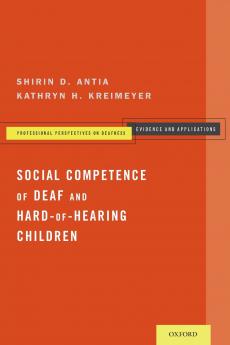
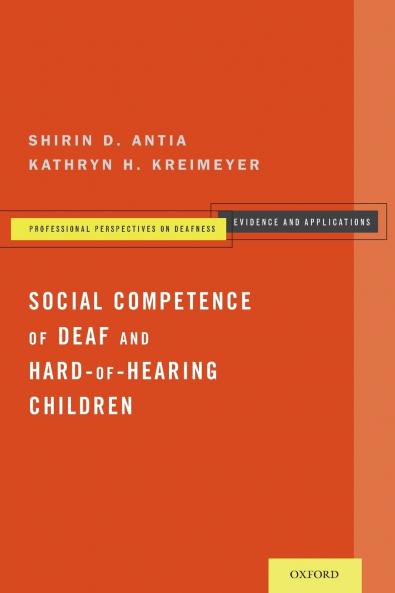
Social Competence of Deaf and Hard-of-Hearing Children addresses the development assessment and promotion of social competence in children who are deaf or hard-of-hearing (DHH). Most children readily develop social competence through the mutually dependent development of social skills and social relationships. Why then write a book on the social competence of DHH children? Hearing loss with its resulting communication challenges has the potential to impede the development of social skills and restrict social relationships. In this volume Shirin D. Antia and Kathryn H. Kreimeyer highlight multiple strategies that teachers families and community members can utilize to promote the social competence of DHH children.The authors approach this topic by first describing the development and expression of social competence in infants as well as in preschool- and school-age hearing and DHH children. Socially competent children display a flexible repertoire of social behaviors that are appropriately utilized in varying social situations and which further children''s social goals. Since social competence develops initially through interactions between infants and their caretakers a primary consideration for children with hearing loss is that the infant and caretaker share a common communication approach to facilitate early interaction. As infants become preschool age opportunities for interactions with other children increase and social interactions revolve around play. The development of interactive and of pretend play requires children to communicate with one another to assume roles share fantasies and solve social conflicts. DHH children must develop communication skills to participate in interactive play and hearing children may need guidance to successfully engage with DHH peers. For school-age children the importance of peer acceptance increases; DHH children need supportive situations both within and outside of school to interact with peers develop friendships and refine the social behaviors that promote peer acceptance. The authors present a variety of practical ways to assess the social competence of DHH children. They emphasize the role of assessment in identifying social strengths and needs to establish a basis for any necessary intervention. They then present ways to promote social competence with a separate focus on strategies appropriate for young DHH children and for school-age DHH children. For both age groups the authors address the role of families professionals schools and communities in helping children develop the skills needed to become socially competent individuals. This book will be a valuable resource for the parents and families of DHH children for the general and special educators who teach these children and for the researchers who describe development and evaluate the effectiveness of strategies to promote the social competence of DHH children.
Piracy-free
Assured Quality
Secure Transactions
Delivery Options
Please enter pincode to check delivery time.
*COD & Shipping Charges may apply on certain items.
Review final details at checkout.
Details
ISBN 13
9780199957736
Publication Date
-29-06-2015
Pages
-298
Weight
-427 grams
Dimensions
-156x234x15.87 mm
