


English



Hardback
₹15887
₹18467
13.97% OFF
(All inclusive*)
Delivery Options
Please enter pincode to check delivery time.
*COD & Shipping Charges may apply on certain items.
Review final details at checkout.
Looking to place a bulk order? SUBMIT DETAILS
Delivery Options
Please enter pincode to check delivery time.
*COD & Shipping Charges may apply on certain items.
Review final details at checkout.
About The Book
Description
Author
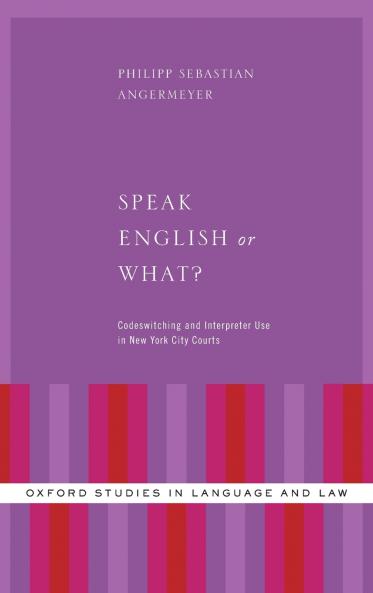
This book presents a study of interpreter-mediated interaction in New York City small claims courts drawing on audio-recorded arbitration hearings and ethnographic fieldwork. Focusing on the language use of speakers of Haitian Creole Polish Russian or Spanish the study explores how these litigants make use of their limited proficiency in English in addition to communicating with the help of professional court interpreters. Drawing on research on courtroom interaction legal interpreting and conversational codeswitching the study explores how the ability of immigrant litigants to participate in these hearings is impacted by institutional language practices and underlying language ideologies as well as by the approaches of individual arbitrators and interpreters who vary in their willingness to accommodate to litigants and share the burden of communication with them. Litigants are shown to codeswitch between the languages in interactionally meaningful ways that facilitate communication but such bilingual practices are found to be in conflict with court policies that habitually discourage the use of English and require litigants to act as monolinguals using only one language throughout the entire proceedings. Moreover the standard distribution of interpreting modes in the courtroom is shown to disadvantage litigants who rely on the interpreter as consecutive interpreting causes their narrative testimony to be less coherent and more prone to interruptions while simultaneous interpreting often leads to incomplete translation of legal arguments or of their opponent''s testimony. Consequently the study raises questions about the relationship between linguistic diversity and inequality arguing that the legal system inherently privileges speakers of English.

Piracy-free

Assured Quality

Secure Transactions

Fast Delivery

Sustainably Printed
Details
ISBN 13
9780199337569
Publication Date
-01-04-2015
Pages
-260
Weight
-466 grams
Dimensions
-156x234x19.05 mm
