


English


Hardback
₹2636
₹2838
7.12% OFF
(All inclusive*)
Delivery Options
Please enter pincode to check delivery time.
*COD & Shipping Charges may apply on certain items.
Review final details at checkout.
Looking to place a bulk order? SUBMIT DETAILS
Delivery Options
Please enter pincode to check delivery time.
*COD & Shipping Charges may apply on certain items.
Review final details at checkout.
About The Book
Description
Author
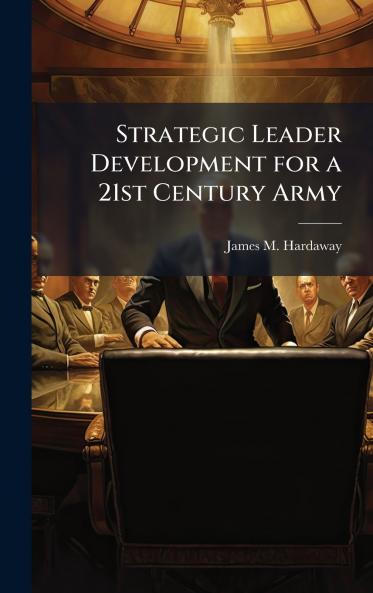
<p>As the nature of warfare evolves the Army must produce leaders who comfortably interact with diverse populations and embrace complexity. This emerging truth dictates a need for change in how Army officers are trained and selected to lead at the highest levels in order to regain the initiative in managing today's fluid operational environment. The concept of strategic leadership therefore must be examined closely in Army doctrine. Social cultural and complex problem-solving skills are becoming a priority and must be developed in young officers to provide enough knowledge for senior leaders to leverage later in their careers. Rarely does the typical Army career prepare someone to succeed in the strategic arena where the non-military elements of national power carry greater effects than large numbers of troops and equipment. The basic question addressed in this study is how effective is the U.S. Army at developing strategic thinkers capable of leading decisively in complex and adaptive environments? To answer this question three distinct areas are analyzed: (1) the ability of the Officer Education System (OES) to distinguish critical abilities deemed necessary to succeed in the modern security environment (2) the ability of the Officer Evaluation Reporting System (OERS) to measure an individual's dedication to self study and lifelong education and (3) the ability of the same OERS to measure individual skills acquired through operational experience. The Army's current OES pushes the most complex topics to the final stages of an officer's educational career. As a result few officers get a chance to expand their intellectual boundaries through critical and creative thinking prior to their field grade experience. Doing business this way denies the opportunity for junior level officers to develop the requisite skills needed to excel in the strategic arena. The Army must promote advanced educational opportunities as healthy and necessary to a young officer's care</p><p>This work has been selected by scholars as being culturally important and is part of the knowledge base of civilization as we know it. This work was reproduced from the original artifact and remains as true to the original work as possible. Therefore you will see the original copyright references library stamps (as most of these works have been housed in our most important libraries around the world) and other notations in the work.</p><p>This work is in the public domain in the United States of America and possibly other nations. Within the United States you may freely copy and distribute this work as no entity (individual or corporate) has a copyright on the body of the work.</p><p>As a reproduction of a historical artifact this work may contain missing or blurred pages poor pictures errant marks etc. Scholars believe and we concur that this work is important enough to be preserved reproduced and made generally available to the public. We appreciate your support of the preservation process and thank you for being an important part of keeping this knowledge alive and relevant.</p><br>

Piracy-free

Assured Quality

Secure Transactions

Fast Delivery

Sustainably Printed
Details
ISBN 13
9781025122670
Publication Date
-22-05-2025
Pages
-60
Weight
-192 grams
Dimensions
-156x234x6.35 mm
