


English



Paperback
₹1638
₹1659
1.27% OFF
(All inclusive*)
Delivery Options
Please enter pincode to check delivery time.
*COD & Shipping Charges may apply on certain items.
Review final details at checkout.
Looking to place a bulk order? SUBMIT DETAILS
Delivery Options
Please enter pincode to check delivery time.
*COD & Shipping Charges may apply on certain items.
Review final details at checkout.
About The Book
Description
Author
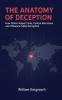
<p>In an age of permanent crises instant narratives and globalized fear <em>The Anatomy of Deception</em> offers a rigorous exploration of how states shape public perception when the stakes are highest. Blending political science intelligence studies and contemporary history this book examines the complex machinery through which governments manage crises influence interpretation and at times allow events to become tools of strategy rather than mere accidents of fate.</p><p>From the structural reasons why governments manipulate information to the psychological mechanisms that make populations vulnerable to rapid narratives William Kergroach guides the reader into the heart of what he calls the gray zone-the space where official truth strategic silence and narrative engineering intersect. Drawing on declassified archives documented historical episodes and a detailed examination of major crises the book presents a method for understanding how an event can be framed amplified simplified or instrumentalized.</p><p>Part One explores the foundations of state deception: the role of intelligence agencies clandestine capacities media dynamics and cognitive biases. Kergroach shows how shock ambiguity and narrative speed create conditions where early interpretations can become collective memory regardless of later findings. Psychological warfare propaganda and perception management are examined not as abstract theories but as operational tools shaping modern politics.</p><p>Part Two revisits key historical turning points-Pearl Harbor Operation Northwoods Gladio the Cold War the Middle East the rise of Vladimir Putin and more-to illustrate how crises have been used interpreted or exploited. These chapters do not claim universal intent or secret omnipotence; instead they demonstrate how documented facts controversies and institutional behavior patterns reveal recurring mechanisms of power.</p><p>Part Three turns to the 21st century: 9/11 Madrid London Paris Syria Ukraine Africa. Each case shows how contemporary crises unfold simultaneously in physical space and informational space. Whether the events are authentically hostile or politically instrumentalized their impact depends on how they are narratively framed during the first hours.</p><p>Part Four offers a practical methodology for reading crises with critical discipline: distinguishing hypotheses from proof analyzing official reports identifying weak signals avoiding conspiratorial shortcuts and recognizing the traps of cognitive reduction.</p><p>Finally Part Five examines the future of conflict: cognitive warfare controlled chaos deepfakes algorithmic influence and the weaponization of perception. Kergroach argues that the democracies of tomorrow will not be threatened primarily by military invasions but by the erosion of their collective ability to discern truth from narrative.</p><p><em>The Anatomy of Deception</em> is not a book of suspicion. It is a book of lucidity. It invites readers to navigate complexity without falling into paranoia to question without denying reality and to understand that modern power lies as much in information as in force. In a world where images precede investigations and interpretations overshadow facts this work offers an indispensable framework for anyone seeking to understand how crises truly shape our century.</p>

Piracy-free

Assured Quality

Secure Transactions

Fast Delivery

Sustainably Printed
Details
ISBN 13
9798232374419
Publication Date
-09-12-2025
Pages
-144
Weight
-152 grams
Dimensions
-127x203x8.52 mm
