

English


₹8008
₹8277
3.25% OFF
(All inclusive*)
Paperback
Delivery Options
Please enter pincode to check delivery time.
*COD & Shipping Charges may apply on certain items.
Review final details at checkout.
Looking to place a bulk order? SUBMIT DETAILS
Delivery Options
Please enter pincode to check delivery time.
*COD & Shipping Charges may apply on certain items.
Review final details at checkout.
About The Book
Description
Author
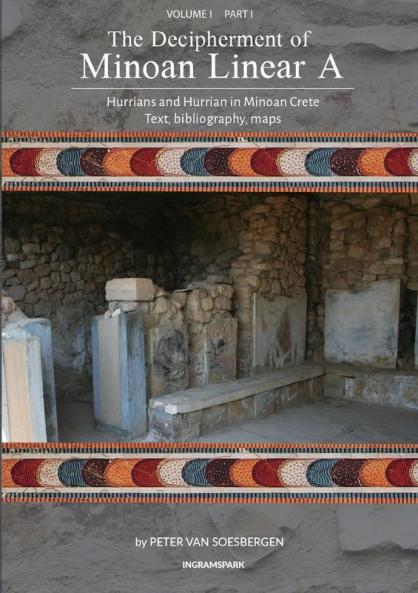
The Minoan Linear A script has mystified scholars over the last 70 years. The first Linear A clay tablets discovered from 1900 A.D. at Knossos Phaistos and Hagia Triada puzzled some of the greatest minds in the linguistic field especially after Michael Ventris's decipherment of the younger related script of Linear B as Mycenaean Greek in 1952. Many attempts to identify Linear A as Semitic Hittite Luwian and even Greek resulted into failure. Some people thought that a Rosetta stone was crucial for the decipherment of Linear A. Disappointment even led to the view that the language written with Linear A might be extinct and remain unknown. Through systematic linguistic research Peter van Soesbergen has established that the Linear A script records an agglutinative language. Hurrian the dominant language of the kingdom of Mitanni (Northern Iraq Eastern Anatolia Syria) turned out to be the best candidate especially because dominance of Mitanni in the Near East was approximately contemporary with Minoan Linear A in Crete. The excavations at Urkish / Tell Mozan showed that Hurrians were already present in Syria in the third millennium B.C. The Decipherment of Minoan Linear A Volume I reads like a detective novel as the evidence is revealed page by page. Van Soesbergen has been able to identify lots of Hurrian personal names ethnics toponyms and theonyms in Linear A. Important are the typical Hurrian grammatical forms with Hurrian suffixes. While the extensive linguistic evidence may be challenging to the layman the wealth of information contained within the entire works remains rewarding and enlightening. Volume I Part I and II comprise the main text in the series The Decipherment of Minoan Linear A whereas Volume I Parts III-VI offer the indices to the main text and glossaries at the same time. Volume II Parts I(Arkhanes - Kea)and Part II (Khania - Zakros) contain the Corpus of transliterated Linear A texts. The spiral Linear A inscription a-re-ne-si-di-jo-pi-ke-pa-ja-su-l/ra-i-te-l/ra-me-a-ja-ku (KN Zf 13) on a gold signet-ring from the necropolis of Mavro Spilio near Knossos probably consists of six sequences: a-re-ne ( ) si-di-jo-pi ( ) ke-pa-ja ( ) su-l/ra-i ( ) te-l/ra-me ( ) a-ja-ku that can be analysed as {Ar-ene=s} {Sid=i-j=o/umbi} {Kebaja} {zul(l)=ai} {Telame} {Aya=k(k)=un} and be translated: 'In order that [the priest] Ar-ene ('Give oh God !') may connect (final debitive zul(l)=ai) Si(n)dijombi and Kebaja (in wedlock with this wedding-ring) oh Great Ajak(k)un (vocative) !'. Can it be accidental that Linear A te-l/ra-me = Hurrian telame / talame / talme 'great' precedes a-ja-ku in this inscription and that we have here the Linear A prototypes of T?????? (Telamon) and his father A???ó? (Ajakos) grandfather of the 'Great' A??? (Ajas) together in one inscription ? A-ya-ku-un is a Hurrian divine name cf. E. Laroche Glossaire de la langue hourrite Paris 1980 40 s.v. ayakki: Nom divin: a-ya-ku-un = oug. a-ya-ku RS quadr. 137 IV b 15 (Série An No 48) ?

Piracy-free

Assured Quality

Secure Transactions

Fast Delivery

Sustainably Printed
Details
ISBN 13
9789083275406
Publication Date
-14-09-2022
Pages
-512
Weight
-1230 grams
Dimensions
-210x297x26.15 mm
