

English


₹8010
₹8277
3.23% OFF
(All inclusive*)
Paperback
Delivery Options
Please enter pincode to check delivery time.
*COD & Shipping Charges may apply on certain items.
Review final details at checkout.
Looking to place a bulk order? SUBMIT DETAILS
Delivery Options
Please enter pincode to check delivery time.
*COD & Shipping Charges may apply on certain items.
Review final details at checkout.
About The Book
Description
Author
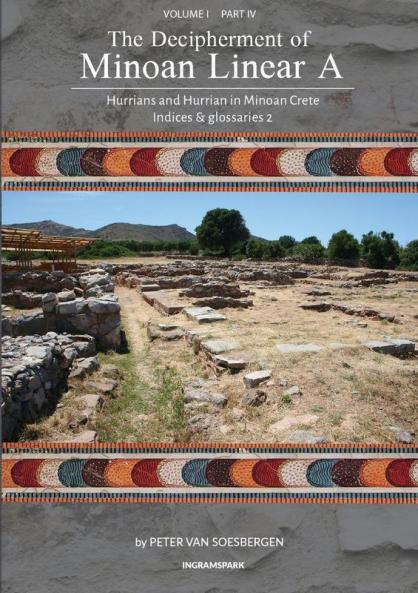
THE DECIPHERMENT OF MINOAN LINEAR A - VOLUME I - PART IV It is significant that at least three toponyms can be recognized in the Messara-valley that have a Hurrian origin. The oldest is Linear A pa-i-to (HT 97a.3; HT 120.6). It is a genuine Hurrian toponym meaning'He/She (a God/the King) has built (the palace)' and it is equivalent to Old Hurrian ba-'à-ás-to/um in the Tis-atal inscription analysed and normalised as pa=ast=o=m and translated as 'He (Tis-atal) has built (a temple)' cf. Th. Richter (BGH 285-286) s.v. pa- pa?- II [passim] 'to build' pa('/h)- cf. G. Wilhelm 1988b 55. The following phases of phonetic development are likely: ba-'à-ás-to/um = pa('/h)=ast=o=m > pa=j=ast=o=m > pa=j=(a)st=o=m > pa=j=st=o=m (wr. pa-i-to in Linear A). Transitional glide -j- (-i- in Linear A pa-i-to) distinguished -a- of the root pa- from the -a- of root-extension -ast- and eventually the -a- of -ast- disappeared as a result of syncope. For Linear B pa-i-to (KN Da 1163+1400 al.) the Old Hurrian ending in =o=m had to be changed into a Hellenized form in -o? (-os): ??????? (Phaistos). The ancient name of the palace of Hagia Triada ka-pa (frequent in Linear A but only at Hagia Triada) was the first Hurrian toponym detected in Linear A and interpreted as ?alba Hurrian name of Aleppo (?alab in Semitic) with the Linear A ethnic ka-pa-qe (HT 6a.4-5) = syllabic cuneiform ?alba?e = alphabetic cuneiform ?lb? 'Man of ?alba' 'Man of Aleppo' (Hurrian ethnic suffix -?e).Toponym ka-pa and ethnic ka-pa-jo (with Greek ethnic suffix -yo?) were already known from the Linear B tablets from Knossos. Linear A ku-mi (HT 110a.1) may well be the Minoan-Hurrian toponym Kummi present Kommos the Minoan harbour of Phaistos and Hagia Triada on the south coast of Crete recently excavated by the Canadian G. Cadogan and his team. Cretan Kummi is probably derived from the name of the city of Kumma/e/ior Kummiya in Anatolia derived from Hurrian kum- 'to build / erect / pile up'. If this identification is correct it is after ka-pa = ?alba (present Hagia Triada) the second Cretan site named after a famous predominantly Hurrian city in the Near East.

Piracy-free

Assured Quality

Secure Transactions

Fast Delivery

Sustainably Printed
Details
ISBN 13
9789083275437
Publication Date
-17-09-2022
Pages
-514
Weight
-1235 grams
Dimensions
-210x297x26.25 mm
