


English


₹7937
₹8277
4.11% OFF
(All inclusive*)
Paperback
Delivery Options
Please enter pincode to check delivery time.
*COD & Shipping Charges may apply on certain items.
Review final details at checkout.
Looking to place a bulk order? SUBMIT DETAILS
Delivery Options
Please enter pincode to check delivery time.
*COD & Shipping Charges may apply on certain items.
Review final details at checkout.
About The Book
Description
Author
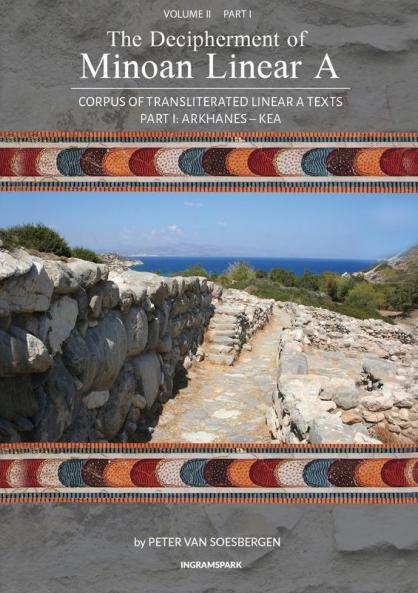
For a long time many scholars hesitated to transliterate Minoan Linear A as long as there was no decisive evidence that the phonetic values of Linear A signs were essentially the same as those of their Linear B counterparts. The question as to whether graphic identity of Linear A and B signs does or does not reflect phonetic identity was tested with the help of computer methods by D.W. Packard first in an unpublished doctoral thesis at Harvard A study of the Minoan Linear A tablets 1967 then in two articles and finally in a monograph Minoan Linear A Berkeley-Los Angeles-London 1974. He constructed nine fictitious decipherments redistributing the Linear B phonetic values among the Linear A signs in such a way that no sign had the same value in any of them. To avoid unwarranted variations affecting the results he re-allocated the values only to signs within the same range of frequency. In a tenth 'decipherment' he used the Ventris's values of signs showing graphic identity in Linear A and B. Considering the results within Linear A the ratio of so-called confirmatory alternations is just over 2: 1 in favour of decipherment by the Ventris's values over the average result of the fictitious decipherments. M. Pope and J. Raison 'Linear A: Changing perspectives' in Études minoennes I BCILL 14 (1978) ed. Y. Duhoux 24-25 found that Packard's results were even better (3: 1) if they were adjusted for context. Rightly they argued that confirmatory alternations are more significant if the contexts are similar so that we are likely to be dealing with words and names from the same semantic sphere. Likewise comparing Linear A with Linear B the ratio of confirmatory alternations is just over 3: 1 in favour of decipherment by the Ventris's values and what is more important: if the Linear A matches with Linear B from Knossos are separated from those from the mainland the ratio is 5: 1 for Knossos and 4: 3 for the mainland. These results offered so much confidence that J. Raison and M. Pope could provide 'Le vocabulaire du linéaire A en translitération' in the same issue of Études minoennes I 131-190. All texts are provided with information about the joins that have been made inventory numbers in the musea certain (c.q. probable) dating based on the finding place and datable context bibliographical information a critical apparatus in which the different readings of respective editors are compared. The author hopes that this publication will contribute to the quality of philological and linguistic research on Linear A. It is advisable to consult the editions with good photographs of the texts in particular L. Godart - J.-P. Olivier Recueil des inscriptions en linéaire A Vol. 1-5 Études Crétoises XXI 1-5 Paris 1976-1985. The revised edition of the Corpus contains a new Linear A text found during the recent excavations at Gournia and some new readings. The first Linear A grid contained The main Linear A phonetic signs according to the Linear B syllabary. The revised edition contains a second Linear A grid in which the phonetic signs correspond with Hurrian cuneiform phonetic values. Based on confirmatory matches the phonetic values of some Linear A signs could be identified cf. Volume I Part I Chapter 12: From undeciphered to deciphered Linear A signs. These values are now incorporated in the transliterated Linear A texts.

Piracy-free

Assured Quality

Secure Transactions

Fast Delivery

Sustainably Printed
Details
ISBN 13
9789083275468
Publication Date
-24-09-2022
Pages
-416
Weight
-1005 grams
Dimensions
-210x297x21.58 mm
