

English


Paperback
₹1437
₹1798
20.08% OFF
(All inclusive*)
Delivery Options
Please enter pincode to check delivery time.
*COD & Shipping Charges may apply on certain items.
Review final details at checkout.
Looking to place a bulk order? SUBMIT DETAILS

Piracy-free

Assured Quality

Secure Transactions
About The Book
Description
Author
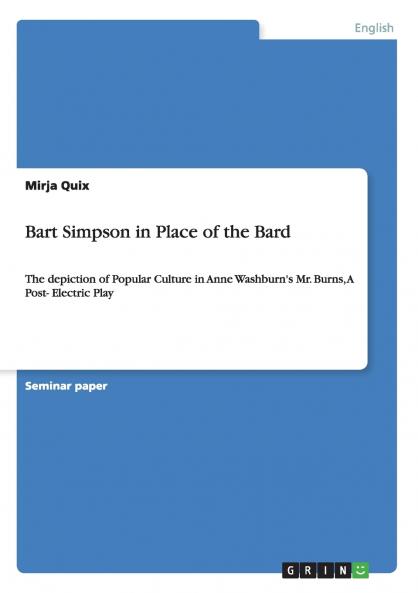
Seminar paper from the year 2014 in the subject English Language and Literature Studies - Literature grade: 20 University of Cologne (Englisches Seminar) course: The London Stage language: English abstract: A main objective of The Simpsons series seems to be to take every day issues and world events as a part of its stories and to deal with them in a satirical way. While it also concerns itself with apparently banal issues like popular movies or bands war politics or nuclear power do not make an exception in the series' content. Mick Broderick points out that while many episodes ostensibly do not touch on nuclear themes the ever- present influence and immanence of the atomic age pervades The Simpsons like a thematic half- life whose motifs contaminate the multi- layered intertextual narratives of each episode often as satire. At this background Anne Washburn's decision to take The Simpsons of all things as the one part of popular culture that survives inside the people's memories throughout a nuclear apocalypse seems even more peculiar and ironic. But that's just what happens in Washburn's Mr. Burns - A post- electric play. The electric grid is destroyed and people have to adapt to a world without telephones television electric stoves or radiators. They have to revert to older ways of engagement like storytelling but instead of higher literature they reminisce about parts of popular culture everyone remembers.The following paper therefore will analyse Anne Washburn's play in regard to the way popular culture is represented in her post- apocalyptic world. Why is it important and why is The Simpsons Washburn's main representative of contemporary popular culture in the play? And moreover in which ways does the representational form of popular culture change throughout it?
Piracy-free
Assured Quality
Secure Transactions
Delivery Options
Please enter pincode to check delivery time.
*COD & Shipping Charges may apply on certain items.
Review final details at checkout.
Details
ISBN 13
9783668010055
Publication Date
-03-08-2015
Pages
-24
Weight
-44 grams
Dimensions
-148x210x1.46 mm
