

English



Paperback
₹659
₹960
31.35% OFF
(All inclusive*)
Delivery Options
Please enter pincode to check delivery time.
*COD & Shipping Charges may apply on certain items.
Review final details at checkout.
Looking to place a bulk order? SUBMIT DETAILS
Delivery Options
Please enter pincode to check delivery time.
*COD & Shipping Charges may apply on certain items.
Review final details at checkout.
About The Book
Description
Author
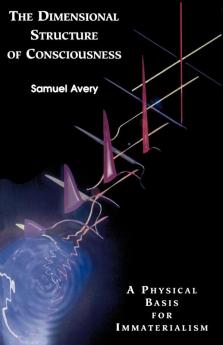
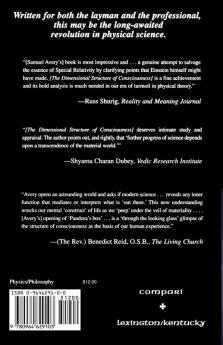
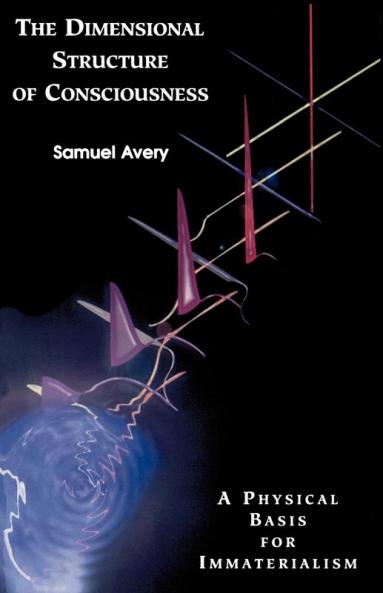
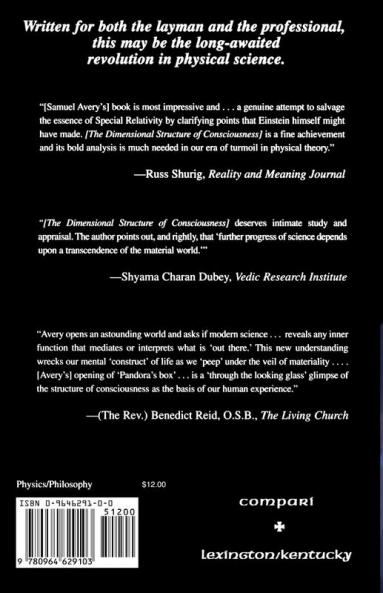
Written for both the layman and the professionsl this may be the long-awaited revolution in physical science. review "the dimensional structure of consciousness deserves intimate study and appraisal. the author points out, and rightly, that 'further progress of science depends upon a transcendence of the material world.'" </br>shyama charan dubey, vedic research institute from the back cover "written for both the layman and the professional, this may be the long-awaited revolution in physical science."[samuel avery's] book is most impressive and... a genuine attempt to salvage the essence of special relativity by clarifying points that einstein himself might have made. [the dimensional structure of consciousness] is a fine achievement and its bold analysis is much needed in our era of turmoil in physical theory." (russ shurig, reality and meaning journal) "[the dimensional structure of consciousness] deserves intimate study and appraisal. the author points out, and rightly, that 'further progress of science depends upon a transcendence of the material world.'" (shyama charan dubey, vedic research institute). "avery opens an astounding world and asks if modern science.. reveals any inner function that mediates or interprets what is 'out there.' this new understanding wrecks our mental 'construct' of life as we 'peep' under the veil of materiality... [avery's] opening of a 'pandora's box'... is a 'through the looking glass' glimpse of the structure of consciousness as the basis of our human experience." (the rev.benedict reid, o.s.b., the living church). born 4/21/49 b.a. oberlin college m.a. university of kentucky teacher, philosopher, gardener, builder excerpt. © reprinted by permission. all rights reserved. from chapter i: introduction:science is the great power of western civilization. the power of science is its ability to establish new truths without reference to fundamentals, to progress beyond prejudice and opinion, and to open the physical world to human manipulation. the great weakness of science is it inability to include all of experience. thought, imagination, and experience itself cannot be the proper subjects of scientific study, and are thereby excluded from the world presented by science. this is the great weakness of western civilization. it is my belief that the world of science is not the world itself, but a special structure of consciousness experience within a larger context. i have come to this conclusion because of what science itself, particularly modern physics, has discovered about nature. we have learned through quantum mechanics, for example, that extremely small pieces of matter are not "in" space and time in the normal sense, and that there are "particles" which have no mass, electrical charge, intrinsic size or shape. through relativity theory we have learned that a moving object is prevented by a property of empty space from traveling faster than light, and that as it approaches the speed of light, its time slows and mass increases. the possibilities of absolute time and absolute measure no longer exist. science can explain this only with great violence to the concept of an external, material world that we are "in." i hope to show in this book that the findings of science make better sense if this concept is eliminated entirely. this is no more nor less than good scientific procedure. if findings do not fit theory, it is toward assumptions underlying theory that we should look. matter is an assumption underlying physics. it serves to explain experience, but is never itself experienced directly. everyone sees, hears, and touches physical objects, but no one sees, hears, or touches matter in any absolute sense. we experience visual and tactile perceptions that suggest a material substance existing independently of perception, but its acceptance as ultimately real is an act of faith. in this the

Piracy-free

Assured Quality

Secure Transactions

Fast Delivery

Sustainably Printed
Details
ISBN 13
9780964629103
Publication Date
-01-12-1995
Pages
-112
Weight
-142 grams
Dimensions
-140x216x6.61 mm
