


English



Paperback
₹999
₹1012
1.28% OFF
(All inclusive*)
Delivery Options
Please enter pincode to check delivery time.
*COD & Shipping Charges may apply on certain items.
Review final details at checkout.
Looking to place a bulk order? SUBMIT DETAILS

Piracy-free

Assured Quality

Secure Transactions
About The Book
Description
Author
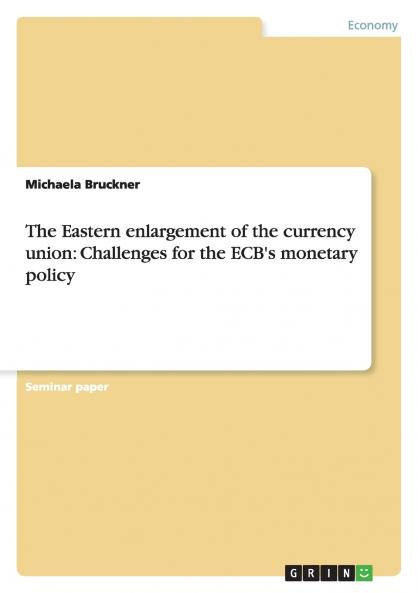
Seminar paper from the year 2007 in the subject Business economics - Economic Policy grade: 20 University of Hohenheim (Lehrstuhl für Außenwirtschaft) course: International Institutions language: English abstract: The eurozone member countries have agreed to permanently abandon economic policy instruments such as monetary and exchange rate policies and to accept the European Central Bank (ECB) as the decision making body to determine the common monetary policy notably the interest rates and the money supply. It goes without saying that such an institution is not able to fine-tune its decisions in order to meet particular economic challenges in certain member countries. In this respect the eastward enlargement of the European Monetary Union (EMU) will bring major challenges to the ECB as varying inflation rates in different member countries and the determination of a single interest rate may have disruptive consequences. From the viewpoint of the eastward enlargement of the eurozone the paper illustrates the various challenges the ECB inevitably has to face. Further it describes the reform of the ECB Governing Council. An important question concerning the ECB is the following: Is there a danger for the single European monetary policy from letting Central and Eastern European Countries (CEEC) join the eurozone or from letting them join the eurozone too early?
Piracy-free
Assured Quality
Secure Transactions
Delivery Options
Please enter pincode to check delivery time.
*COD & Shipping Charges may apply on certain items.
Review final details at checkout.
Details
ISBN 13
9783640344093
Publication Date
-12-06-2009
Pages
-24
Weight
-44 grams
Dimensions
-148x210x2.04 mm
