



English


Hardback
₹2012
(All inclusive*)
Delivery Options
Please enter pincode to check delivery time.
*COD & Shipping Charges may apply on certain items.
Review final details at checkout.
Looking to place a bulk order? SUBMIT DETAILS
Delivery Options
Please enter pincode to check delivery time.
*COD & Shipping Charges may apply on certain items.
Review final details at checkout.
About The Book
Description
Author(s)
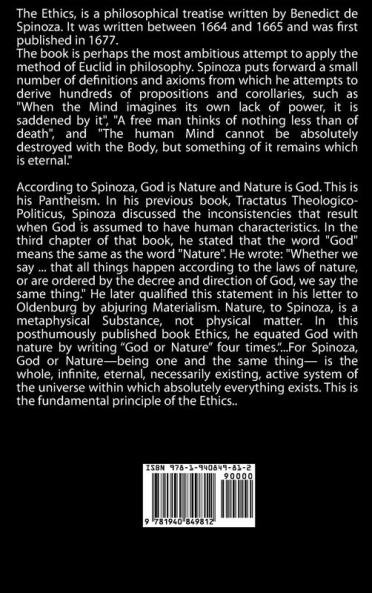
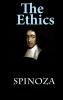
<p>The book is perhaps the most ambitious attempt to apply the method of Euclid in philosophy. Spinoza puts forward a small number of definitions and axioms from which he attempts to derive hundreds of propositions and corollaries such as &quot;When the Mind imagines its own lack of power it is saddened by it&quot; &quot;A free man thinks of nothing less than of death&quot; and &quot;The human Mind cannot be absolutely destroyed with the Body but something of it remains which is eternal.&quot;</p><p>According to Spinoza God is Nature and Nature is God. This is his Pantheism. In his previous book Tractatus Theologico-Politicus Spinoza discussed the inconsistencies that result when God is assumed to have human characteristics. In the third chapter of that book he stated that the word &quot;God&quot; means the same as the word &quot;Nature&quot;. He wrote: &quot;Whether we say ... that all things happen according to the laws of nature or are ordered by the decree and direction of God we say the same thing.&quot; He later qualified this statement in his letter to Oldenburg by abjuring Materialism. Nature to Spinoza is a metaphysical Substance not physical matter. In this posthumously published book Ethics he equated God with nature by writing &ldquo;God or Nature&rdquo; four times.&ldquo;...For Spinoza God or Nature&mdash;being one and the same thing&mdash; is the whole infinite eternal necessarily existing active system of the universe within which absolutely everything exists. This is the fundamental principle of the Ethics..</p>

Piracy-free

Assured Quality

Secure Transactions

Fast Delivery

Sustainably Printed
Details
ISBN 13
9781940849812
Publication Date
-30-05-2018
Pages
-208
Weight
-377 grams
Dimensions
-152x229x12.7 mm
