




This Book is Out of Stock!
English




Hardback
₹451
(All inclusive*)
Delivery Options
*COD & Shipping Charges may apply on certain items.
Review final details at checkout.
Looking to place a bulk order? SUBMIT DETAILS
*COD & Shipping Charges may apply on certain items.
Review final details at checkout.
₹451
Out Of Stock
All inclusive*
About The Book
Description
Author
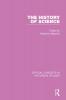
<p>Science is one of the main features of the contemporary world, and shapes our lives to an extent that has no precedents in history. Yet science as we know it today is the outcome of contingent social processes, and its global success is far from self-explanatory. How did it happen? How did science emerge in history and became the most authoritative source of knowledge available in late modern societies? This set of volumes address these crucial questions through a selection of exemplary publications spanning antiquity to the present day. The reader will find an effective survey of the best scholarship in this rapidly growing field, and a map of the main revolutions as well as the long-term continuities that have characterized our understanding the world and our attempts to control it. The volumes bring together areas of inquiry that have become increasingly distant and specialized - such as the history of antique science or Cold War studies - within broader narratives of the making of the modern world. They also reassess the traditional assumption of the exclusively Greek and Western origins of modern science, situating relevant knowledge, practices, and artifacts within the global networks that sustained them – in ancient as well as in modern times. The contributions will address key historiographical issues such as the relationship between science, magic, and religion; the role of science in nation-building processes; and the relationship between science and technology. Throughout the volumes, authors will also engage with broader theoretical issues such as the distribution of agency in the making of science; the way scientific knowledge is made universal; and the interplay of science, technology, and politics. </p> <p>Volume 2: Medieval Science</p><p>17. Edward Grant, ‘When Did Modern Science Begin?’, <i>The American Scholar, </i>66, 1997, 105–113. </p><p>18. David C. Lindberg, ‘Science and the Early Christian Church’, <i>Isis</i>, 74, 1983, 509-530.</p><p>19. Abdelhamid Sabra, ‘Situating Arabic Science: Locality Versus Essence, <i>Isis</i>, 87, 1996, 654-670. </p><p>20. David Pingree, ‘The Logic of Non-Western Science: Mathematical Discoveries in Medieval India’, <i>Daedalus</i>, 132, 2003, 45-54. </p><p>21. Maria Mavroudi, ‘Occult Science and Society in Byzantium: Considerations for Future Research’, in P. Magdalino and M. Mavroudi (eds), <i>The Occult Sciences in Byzantium</i>, (Geneva: La Pomme d’Or, 2006), pp. 39–95.</p><p>22. Robert G. Morrison,’<i> </i>Natural Theology and the Qur’ān’, <i>Journal of Qur’ānic Studies</i>, 2013, 15, 1-22. </p><p>23. F. Jamil Ragep, ‘Freeing Astronomy from Philosophy: An Aspect of Islamic Influence on Science’, <i>Osiris,</i> 16, 2001, 49-71. </p><p>24. Charles Burnett, ‘The Transmission of Arabic Astronomy via Antioch and Pisa in the Second Quarter of the Twelfth Century’, in J. P. Hogendijk and A. I. Sabra (eds),<i> The Enterprise of Science in Islam: New Perspectives</i> (MIT Press, 2003), pp. 23–51. </p><p>25. Y. Tzvi Langermann, ‘Cosmology and Cosmogony in <i>Doresh Reshumot</i>, a Thirteenth Century Commentary on the Torah’, <i>Harvard Theological Review</i>, 97, 2004, 199-227.</p><p>26. Jean-Patrice Boudet, ‘A "College of Astrology and Medicine"? Charles V, Gervais Chrétien, and the Scientific Manuscripts of Maître Gervais’s College’,<i> Studies in History and Philosophy of Biological and Biomedical Sciences</i>, 41, 2010, 99-108. </p><p>27. Leah DeVun, ‘The Jesus Hermaphrodite: Science and Sex Difference in Premodern Europe’, <i>Journal of the History of Ideas,</i>69, 2008, 193-218. </p><p>28. Monica H. Green, ‘Gendering the History of Women’s Healthcare’, <i>Gender &amp; History</i>, 20, 2008, 487–518. </p><p>29. Joel Kaye, ‘The Impact of Money on the Development of Fourteenth-Century Scientific Thought’, <i>Journal of Medieval History</i>, 14, 1988, 251-270. </p><p>30. William Newman, ‘Technology and Alchemical Debate in the Late Middle Ages’, <i>Isis, </i>80,<i> </i>1989, 423-445. </p><p>31. Laura Smoller, ‘Defining the Boundaries of the Natural in the Fifteenth-Century Brittany: The Inquest into the Miracles of St. Vincent Ferrer (d. 1419), <i>Viator, </i>28, 1997, 333-359.</p>

Piracy-free

Assured Quality

Secure Transactions

Fast Delivery

Sustainably Printed
Details
ISBN 13
9780415744447
Publication Date
-21-02-2020
Pages
-396
Weight
-653 grams
Dimensions
-156x234x22.34 mm
