




This Book is Out of Stock!
English




Hardback
₹451
(All inclusive*)
Delivery Options
*COD & Shipping Charges may apply on certain items.
Review final details at checkout.
Looking to place a bulk order? SUBMIT DETAILS

Piracy-free

Assured Quality

Secure Transactions
About The Book
Description
Author
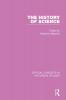
<p>Science is one of the main features of the contemporary world, and shapes our lives to an extent that has no precedents in history. Yet science as we know it today is the outcome of contingent social processes, and its global success is far from self-explanatory. How did it happen? How did science emerge in history and became the most authoritative source of knowledge available in late modern societies? This set of volumes address these crucial questions through a selection of exemplary publications spanning antiquity to the present day. The reader will find an effective survey of the best scholarship in this rapidly growing field, and a map of the main revolutions as well as the long-term continuities that have characterized our understanding the world and our attempts to control it. The volumes bring together areas of inquiry that have become increasingly distant and specialized - such as the history of antique science or Cold War studies - within broader narratives of the making of the modern world. They also reassess the traditional assumption of the exclusively Greek and Western origins of modern science, situating relevant knowledge, practices, and artifacts within the global networks that sustained them – in ancient as well as in modern times. The contributions will address key historiographical issues such as the relationship between science, magic, and religion; the role of science in nation-building processes; and the relationship between science and technology. Throughout the volumes, authors will also engage with broader theoretical issues such as the distribution of agency in the making of science; the way scientific knowledge is made universal; and the interplay of science, technology, and politics. </p> <p>Volume 3: Early Modern Science</p><p>32. Roy Porter, ‘The Scientific Revolution: A Spoke in the Wheel?’, in R. Porter and M. Teich (eds), <i>Revolution and History</i> (Cambridge University Press, 1986), pp. 290-316. </p><p>33. Brian P. Copenhaver, ‘Did Science Have a Renaissance?’, <i>Isis</i>, 83, 1992, 387-407. </p><p>34. George Saliba, ‘A Sixteenth-Century Arabic Critique of Ptolemaic Astronomy: The Work of Shams al-Din al- Khafri’, <i>Journal for the History of Astronomy</i>, 25, 1994, 15-38.</p><p>35. Robert Morrison, ‘A Scholarly Intermediary Between the Ottoman Empire and Renaissance Europe’, <i>Isis</i>, 105, 2014, 32-57. </p><p>36. John Henry, ‘Animism and Empiricism: Copernican Physics and the Origins of William Gilbert’s Experimental Method’, <i>Journal of the History of Ideas</i>, 62, 2001, 99-119. </p><p>37. Pamela H. Smith, ‘Knowledge in Motion: Following Itineraries of Matter in the Early Modern World’, in Daniel Rogers, Bhavani Raman and Helmut Reimitz (eds), <i>Cultures in Motion </i>(Princeton University Press, 2014), 109-133. </p><p>38. Mario Biagioli, ‘Galileo the Emblem Maker’, <i>Isis</i>, 81, 1990, 230-258.</p><p>39. Paula Findlen, ‘Possessing the Past: The Material World of the Italian Renaissance’, <i>American Historical Review</i>, 103, 1998, 83-114. </p><p>40. Katherine Park, ‘Dissecting the Female Body: From Women’s Secrets to the Secrets of Nature’, in Adele Seeff and Jane Donawerth (eds), <i>Attending to Early Modern Women </i>(Newark: University of Delaware Press, 2000), pp. 29-47. </p><p>41. Peter Dear, ‘Miracles, Experiments, and the Ordinary Course of Nature’, <i>Isis</i>,</p><p>81, 1990, 663-683. </p><p>42. Steven Shapin, ‘The House of Experiment in Seventeenth-Century England’, <i>Isis</i>, 79, 1988, 373-404. </p><p>43. Lawrence M. Principe, ‘Alchemy Restored’, <i>Isis</i>, 102, 2011, 305-312.</p><p>44. Harold J. Cook, ‘Body and Passions: Materialism and the Early Modern State’, <i>Osiris</i>, 17, 2002, 25-48. </p><p>45. Domenico Bertoloni Meli, ‘Patterns of Transformation in Seventeenth-Century Mechanics’, <i>The Monist</i>, 93, 2010, 580-597. </p><p>46. Matthew L. Jones, ‘Descartes's Geometry as Spiritual Exercise’, <i>Critical Inquiry,</i> 28, 2001, 40-71. </p><p>47. Carla Nappi, ‘On Yeti and Being Just: Carving the Borders of Humanity in Early Modern China’, in A. Gross and A. Vallely (eds), <i>Animals and the Human Imagination: A Companion to Animal Studies </i>(Columbia University Press, 2012), pp. 55-78. </p>
Piracy-free
Assured Quality
Secure Transactions
*COD & Shipping Charges may apply on certain items.
Review final details at checkout.
₹451
Out Of Stock
All inclusive*
Details
ISBN 13
9780415744454
Publication Date
-21-02-2020
Pages
-430
Weight
-700 grams
Dimensions
-156x234x24.09 mm
