


English



Paperback
₹1844
₹2058
10.4% OFF
(All inclusive*)
Delivery Options
Please enter pincode to check delivery time.
*COD & Shipping Charges may apply on certain items.
Review final details at checkout.
Looking to place a bulk order? SUBMIT DETAILS

Piracy-free

Assured Quality

Secure Transactions
About The Book
Description
Author
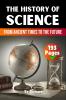
<p><strong>The History of Science</strong> takes you through the <strong>key role science</strong> has played in helping us <strong>understand the world</strong> <strong>improving our lives</strong> and driving <strong>progress</strong>. From <strong>early observations</strong> in prehistoric times to modern advancements in <strong>physics</strong> <strong>genetics</strong> and <strong>artificial intelligence</strong> this book tells the story of how <strong>scientific knowledge</strong> has grown over time.</p><p>Readers will learn about the <strong>achievements of ancient civilizations</strong> like <strong>Mesopotamia</strong> <strong>Egypt</strong> the <strong>Indus Valley</strong> and <strong>China</strong> as well as the early Greek contributions of <strong>Thales</strong> <strong>Pythagoras</strong> and <strong>Aristotle</strong>. The book covers advancements during the Hellenistic period by <strong>Euclid</strong> and <strong>Archimedes</strong> Roman contributions to <strong>building and medicine</strong> and how classical knowledge was saved by <strong>Byzantine</strong> <strong>Islamic</strong> and <strong>monastic scholars</strong>.</p><p></p><p>This book dives into the <strong>Islamic Golden Age</strong> highlighting the work of <strong>Al-Khwarizmi</strong> <strong>Ibn Sina</strong> and <strong>Alhazen</strong>. It covers the <strong>Carolingian Renaissance</strong> the mixing of Greek and Islamic science by scholars like <strong>Thomas Aquinas</strong> and <strong>Roger Bacon</strong> and the growth of <strong>natural philosophy</strong> in medieval universities. The <strong>Renaissance</strong> and the <strong>Scientific Revolution</strong> are brought to life through the work of <strong>Copernicus</strong> <strong>Galileo</strong> <strong>Kepler</strong> and <strong>Newton</strong> along with the creation of the <strong>scientific method</strong> by <strong>Francis Bacon</strong> and <strong>René Descartes</strong>.</p><p></p><p><strong>The History of Science</strong> looks at the role of science in the <strong>Enlightenment</strong> advancements in <strong>chemistry</strong> <strong>biology</strong> and <strong>physics</strong> by <strong>Boyle</strong> <strong>Lavoisier</strong> and <strong>Linnaeus</strong> and the start of scientific societies. The impact of the <strong>Industrial Revolution</strong> is shown through the contributions of <strong>Watt</strong> <strong>Faraday</strong> and <strong>Maxwell</strong> and the beginning of modern chemistry with <strong>Mendeleev's periodic table</strong>.</p><p></p><p>The book covers the growth of scientific knowledge in the <strong>19th century</strong> including <strong>Darwin's theory of evolution</strong> <strong>Maxwell's equations</strong> and the start of modern medicine with <strong>Pasteur</strong> and <strong>Koch</strong>. The early <strong>20th century</strong> brought revolutionary ideas in <strong>quantum mechanics</strong> and <strong>relativity</strong> the discovery of <strong>DNA</strong> and new inventions by <strong>Edison</strong> <strong>Tesla</strong> and <strong>Marconi</strong>. The mid to late 20th century saw the <strong>space race</strong> developments in <strong>computer science</strong> and breakthroughs in <strong>medical science</strong> and <strong>biotechnology</strong>.</p><p></p><p>Finally the book looks at <strong>contemporary science</strong> and <strong>future directions</strong> including modern advancements in <strong>physics</strong> and <strong>cosmology</strong> cutting-edge research in <strong>genetics</strong> <strong>nanotechnology</strong> and <strong>AI</strong> and the role of science in addressing global problems like <strong>climate change</strong> and <strong>public health</strong>. <strong>The History of Science</strong> is a must-read for anyone interested in the growth of scientific knowledge and its big impact on the world.</p>
Piracy-free
Assured Quality
Secure Transactions
Delivery Options
Please enter pincode to check delivery time.
*COD & Shipping Charges may apply on certain items.
Review final details at checkout.
Details
ISBN 13
9783759888471
Publication Date
-10-04-2025
Pages
-194
Weight
-271 grams
Dimensions
-152x229x10.45 mm
