


German
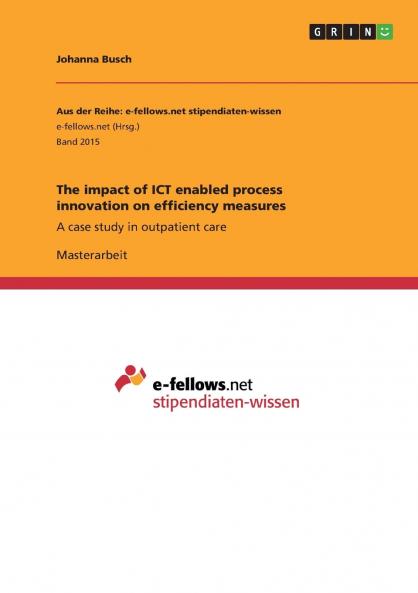


Paperback
₹6658
₹7711
13.66% OFF
(All inclusive*)
Delivery Options
Please enter pincode to check delivery time.
*COD & Shipping Charges may apply on certain items.
Review final details at checkout.
Looking to place a bulk order? SUBMIT DETAILS
Delivery Options
Please enter pincode to check delivery time.
*COD & Shipping Charges may apply on certain items.
Review final details at checkout.
About The Book
Description
Author
Masterarbeit aus dem Jahr 2014 im Fachbereich BWL - Unternehmensführung Management Organisation Note: 13 Universität Mannheim Sprache: Deutsch Abstract: Healthcare is one of the fastest growing sectors in the service economy (Sisko et al. 2009). This development is due to the aging society mounting competitive pressure and ever more emerging treatments and technologies (Andaleeb 2001). Being an enormously expensive very complex information-intensive and universally used service healthcare significantly affects economies and the quality of daily life (Berry & Bendapudi 2007).Since the early 1950s computer technologies have been utilized to collect and manage information (Atienza et al. 2007). The development of computer processing and its implications for the speed memory and possibilities of network infrastructures to process large amounts of data are seen as a promising way to achieve needed changes within healthcare like lowering costs and enhancing quality. These developments have created a wide range of possibilities for individuals groups and populations to assess and deliver health information. However the healthcare sector lags behind other sectors in the utilization of communication and information technology (ICT) and thus exhibits a chance for sustainable growth. Implementations of potentially beneficial e-health technologies are currently in process often with significant impact on national expenditure. The UK has for example invested at least € 16 billion in a national programme for information technology for national health services (Catwell & Sheikh 2009). Such large-scale expenditure has been justified on the grounds that e-health solutions will help address the problems of cost-effectiveness quality and safety in modern healthcare.Despite the surge in technological capabilities the responding research and evaluation methodologies have not kept pace with the evolution of information and communication technologies in healthcare

Piracy-free

Assured Quality

Secure Transactions

Fast Delivery

Sustainably Printed
Details
ISBN 13
9783668262010
Publication Date
-09-08-2016
Pages
-112
Weight
-147 grams
Dimensions
-148x210x6.78 mm
