

English


Paperback
₹2504
₹2642
5.22% OFF
(All inclusive*)
Delivery Options
Please enter pincode to check delivery time.
*COD & Shipping Charges may apply on certain items.
Review final details at checkout.
Looking to place a bulk order? SUBMIT DETAILS
Delivery Options
Please enter pincode to check delivery time.
*COD & Shipping Charges may apply on certain items.
Review final details at checkout.
About The Book
Description
Author
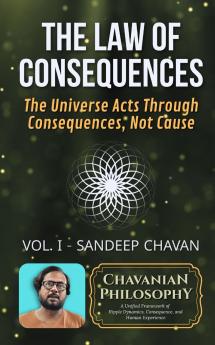
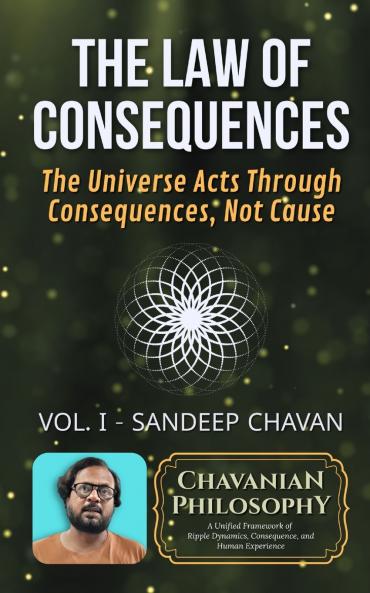
<p><strong>The Law of Consequences</strong> is the first volume in the groundbreaking <em>Chavanian Philosophy</em> series by Sandeep Chavan-a visionary work that reframes reality not through cause but through consequence. In a world dominated by linear thinking deterministic models and blame-based narratives this book offers a radical shift: the universe does not operate on chains of causes pulling the future into existence-it unfolds through ripples of consequence resolving imbalance.</p><p>Drawing from decades of teaching inquiry and lived reflection Chavan introduces the Law of Consequences (LOC) as both a metaphysical foundation and a practical lens. LOC dissolves paradoxes in physics ethics and consciousness offering a unified grammar across domains: imbalance → ripple → resolution. Whether exploring quantum mechanics psychological trauma or leadership ethics the book reveals how consequence-not cause-is the true driver of reality.</p><p>The book opens by tracing humanity's obsession with cause-from primitive myths and religious rituals to scientific revolutions and modern legal systems. Chavan shows how cause-thinking emerged as a survival strategy offering psychological comfort social control and narrative simplicity. Yet this obsession he argues blinds us to the deeper truth: causes vanish the moment they are named. What remains are consequences-ripples resolving misalignment in the universal field.</p><p>In Part I Chavan dismantles the myth of cause with clarity and precision. He exposes its failures in physics (quantum paradoxes relativity) ethics (blame culture systemic blind spots) and everyday life (superstition anxiety oversimplified storytelling). Through vivid examples and participatory reflection he invites readers to shift from asking Who caused this? to What consequence resolved here?</p><p>Part II introduces the Law of Consequences as a living grammar. LOC is not a theory-it is the pattern the universe already follows. Chavan defines Ripple Ontology a framework where reality unfolds through ripple interactions rather than causal chains. He contrasts LOC with the Law of Karma showing how consequence offers freedom from guilt determinism and moral absolutism.</p><p>Part III explores LOC in the natural world. From physical phenomena to biological adaptation and psychological behavior Chavan demonstrates how consequence governs evolution perception and healing. He reframes illness emotion and cognition as ripple responses-not caused events-opening new pathways for understanding and action.</p><p>Part IV turns to human action. Decision-making social systems and leadership are examined through the lens of LOC. Chavan shows how ripple-aware choices dissolve blame and foster alignment. He offers practical insights for navigating complexity resolving conflict and leading with consequence-conscious clarity.</p><p>Part V elevates LOC to a metaphysical foundation. Chavan explores the nature of reality consciousness and freedom-not as abstract ideals but as ripple-resolved states. He argues that true freedom lies not in escaping consequence but in learning to navigate it with awareness. The book closes with an epilogue titled The Ripple of Freedom inviting readers to live by consequence and dissolve inherited illusions.</p><p>Throughout the book Chavan's voice is participatory poetic and precise. He avoids mystification offering a clear ripple-aligned grammar that bridges science philosophy and lived experience. The work includes interludes appendices a glossary and a quote bank for deeper engagement. It is designed not just for intellectual clarity but for emotional resonance and practical transformation.</p><p><strong>The Law of Consequences</strong> is ideal for readers of philosophy science psychology ethics and systems thinking. </p>

Piracy-free

Assured Quality

Secure Transactions

Fast Delivery

Sustainably Printed
Details
ISBN 13
9788199417045
Publication Date
-24-10-2025
Pages
-232
Weight
-238 grams
Dimensions
-127x203x13.41 mm
