



This Book is Out of Stock!
English



Hardback
₹23122
(All inclusive*)
Delivery Options
*COD & Shipping Charges may apply on certain items.
Review final details at checkout.
Looking to place a bulk order? SUBMIT DETAILS

Piracy-free

Assured Quality

Secure Transactions
About The Book
Description
Author(s)
Shoutouts
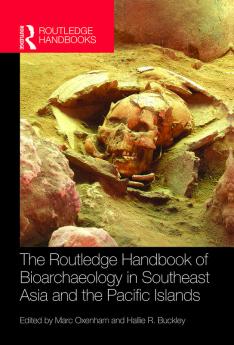
<p>In recent years the bioarchaeology of Southeast Asia and the Pacific islands has seen enormous progress. This new and exciting research is synthesised, contextualised and expanded upon in <em>The Routledge Handbook of Bioarchaeology </em><em>in Southeast Asia and the Pacific Islands</em>.</p><p>The volume is divided into two broad sections, one dealing with mainland and island Southeast Asia, and a second section dealing with the Pacific islands. A multi-scalar approach is employed to the bio-social dimensions of Southeast Asia and the Pacific islands with contributions alternating between region and/or site specific scales of operation to the individual or personal scale. The more personal level of osteobiographies enriches the understanding of the lived experience in past communities.</p><p>Including a number of contributions from sub-disciplinary approaches tangential to bioarchaeology the book provides a broad theoretical and methodological approach. Providing new information on the globally relevant topics of farming, population mobility, subsistence and health, no other volume provides such a range of coverage on these important themes.</p> <p>Chapter 1</p><p><em> <br><p>Bioarchaeology in Southeast Asia and the Pacific</p></em></p><p>HR Buckley and MF Oxenham </p><p>Chapter 2</p><p>The Population History of Mainland and Island Southeast Asia</p><p>MF Oxenham and HR Buckley</p><p>Chapter 3</p><p>Human cultural, technological and adaptive changes from the end of the Pleistocene to the mid-Holocene in Southeast Asia</p><p>PJ Piper</p><p>Chapter 4</p><p>Prehistoric Mortuary Traditions in Cambodia</p><p>D O’Reilly and L Shewan</p><p>Chapter 5</p><p>Frail, foreign or favoured? A contextualized case study from Bronze Age northeast Thailand</p><p>K Domett, J Newton, A Colbert, N Chang, S. Halcrow</p><p>Chapter 6</p><p>Reflections on life and times in Neolithic Vietnam: One person’s story</p><p>L Tilley and MF Oxenham</p><p>Chapter 7</p><p>Investigating Activity and Mobility Patterns during the mid-Holocene in northern Vietnam</p><p>D Huffer and MF Oxenham</p><p>Chapter 8</p><p>Reconstructing diet at An Son and Hoa Diem: implications for understanding southeast Asian subsistence patterns</p><p>A Willis and MF Oxenham</p><p>Chapter 9</p><p>Infant and child health and disease with agricultural intensification in mainland Southeast Asia</p><p>SE Halcrow, N Tayles and CL King</p><p>Chapter 10</p><p>To Follow in Their Footsteps: An Examination of the Burial Identity of the Elderly from Non Nok Tha</p><p>KW Ross and MF Oxenham</p><p>Chapter 11</p><p>Age-at-death estimation in a sample of prehistoric Southeast Asian adolescents and adults</p><p>N Tayles and S Halcrow</p><p>Chapter 12</p><p>Cremation in Mainland Southeast Asia: An Overview</p><p>S.M Ward and N Tayles</p><p>Chapter 13</p><p>Social Affiliation, Settlement Pattern Histories and Subsistence Change in Neolithic Borneo</p><p>L Lloyd-Smith, J Krigbaum and B Valentine</p><p>Chapter 14</p><p>Field anthropology in Southeast Asia and the Pacific: initial steps toward a regional overview and the Pain Haka case study</p><p>N J Harris, H Buckley, SE Halcrow, R Kinaston, A Foster, J-C Galipaud and T Simanjantuk</p><p>Chapter 15</p><p>Dealing with Death in Late Neolithic to Metal Period Nagsabaran, the Philippines</p><p>MF Oxenham, A Willis, H-c Hung, R Page, H Matsumura</p><p>Chapter 16</p><p>Implications of pathological changes in cremated human remains from Palawan, Philippines, for Island Southeast Asian archaeology</p><p>M Lara, H Lewis, V Paz, W Ronquillo</p><p>Chapter 17</p><p>Bioarchaeology in the Pacific Islands: A temporal and geographical examination of nutritional and infectious disease</p><p>H Buckley and MF Oxenham</p><p>Chapter 18</p><p>Human biology and population histories in the Pacific – Is there such thing as a Lapita People?</p><p>E A Matisoo-Smith</p><p>Chapter 19</p><p>Socio-environmental adaption to the montane rainforests of New Guinea</p><p>T Denham</p><p>Chapter 20</p><p>Is there a ‘Lapita diet’? A comparison of Lapita and post-Lapita skeletal samples from four Pacific island archaeological sites</p><p>RL Kinaston, SB Bedford, M Spriggs, D Anson, and H Buckley</p><p>Chapter 21</p><p>Dogs and People in Southeast Asia and the Pacific</p><p>K Greig, R Walter and L Matisoo-Smith</p><p>Chapter 22</p><p>Scratching Out a Living: Chickens in Ancient Pacific Economies</p><p>AA Storey</p><p>Chapter 23</p><p>Adapting to Palau</p><p>GC Nelson, JH Stone, SM. Fitzpatrick</p><p>Chapter 24</p><p>Under the Latte: Osteobiography and Social Context of a Burial Assemblage at Tumon Bay, Guam</p><p>A LW Stodder, EM Ryan, RL Hunter-Anderson, MT Douglas , R Ikehara-Quebral </p><p>Chapter 25</p><p>Diet and subsistence in Remote Oceania: an analysis using oral indicators of diet </p><p>C Stantis, N Tayles, RL Kinaston, C Cameron, PD Nunn, MP. Richards and HR Buckley</p><p>Chapter 26</p><p>Dental Calculus and Plant Diet in Oceania</p><p>M Tromp, JV Dudgeon, HR Buckley, E Matisoo-Smith</p><p>Chapter 27</p><p>What archaeologists want human biologists to tell them, about Teouma for example</p><p>M Spriggs</p><p>Chapter 28</p><p>The Ancestors Speak: Kōiwi tangata, mātauranga Māori and the development of biological anthropology in New Zealand</p><p>K Ruckstuhl, N Tayles, H Buckley, R Bradley, R Fyfe and M Ellison</p><p>Chapter 29</p><p>meta-themes in the bioarchaeology of the Asia pacific region</p><p>MF Oxenham and HR Buckley</p>
Piracy-free
Assured Quality
Secure Transactions
*COD & Shipping Charges may apply on certain items.
Review final details at checkout.
₹23122
Out Of Stock
All inclusive*
Details
ISBN 13
9781138778184
Publication Date
-26-11-2015
Pages
-712
Weight
-1814 grams
Dimensions
-174x246x38.58 mm
Imprint
-Routledge
