



This Book is Out of Stock!
English




Hardback
₹23155
(All inclusive*)
Delivery Options
*COD & Shipping Charges may apply on certain items.
Review final details at checkout.
Looking to place a bulk order? SUBMIT DETAILS

Piracy-free

Assured Quality

Secure Transactions
About The Book
Description
Author
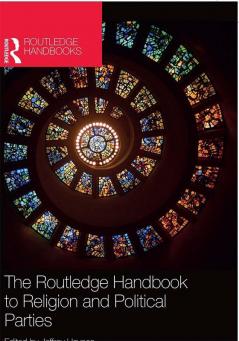
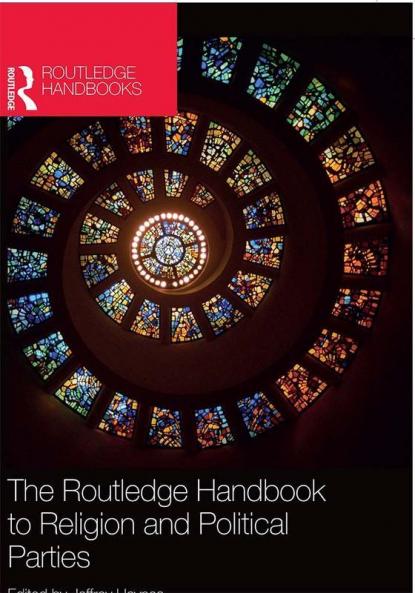
<p>As religion and politics become ever more intertwined, relationships between religion and political parties are of increasing global political significance. This handbook responds to that development, providing important results of current research involving religion and politics, focusing on: democratisation, democracy, party platform formation, party moderation and secularisation, social constituency representation and interest articulation. </p><p>Covering core issues, new debates, and country case studies, the handbook provides a comprehensive overview of fundamentals and new directions in the subject. Adopting a comparative approach, it examines the relationships between religion and political parties in a variety of contexts, regions and countries with a focus on Christianity, Islam, Buddhism, Judaism and Hinduism. Contributions cover such topics as:</p><ul> <p> </p> <li>religion, secularisation and modernisation;</li> <p> </p> <li>religious fundamentalism and terrorism;</li> <p> </p> <li>the role of religion in conflict resolution and peacebuilding;</li> <p> </p> <li>religion and its connection to state, democratisation and democracy; and </li> <p> </p> <li>regional case studies covering Asia, the Americas, Europe, Sub-Saharan Africa, the Middle East and North Africa.</li> </ul><p>This comprehensive handbook provides crucial information for students, researchers and professionals researching the topics of politics, religion, comparative politics, secularism, religious movements, political parties and interest groups, and religion and sociology.</p> <p>Introduction</p><p>Jeffrey Haynes</p><p>PART I Core issues and topics </p><p>1 The next Middle Ages: religion and political culture</p><p>Manlio Graziano</p><p>2 Religion, state and nation: Islamic parties between ideology and religion </p><p>Jocelyne Cesari</p><p>3 Religion and society </p><p>David Herbert</p><p>4 Religion, modernisation and secularisation </p><p>Steven Kettell</p><p>PART II New debates </p><p>5 Religious fundamentalism </p><p>Luca Ozzano</p><p>6 Religion, democratisation and democracy </p><p>Jeffrey Haynes</p><p>7 Religion and party platform formation </p><p>Esen Kirdis</p><p>8 Religion, social constituency representation and interest articulation </p><p>Nil S. Satana, Alperen Özkan and Jóhanna K. Birnir</p><p>9 The politics of being Muslim and female: religion, feminism and hierarchies of knowledge</p><p>Sariya Cheruvallil-Contractor</p><p>10 Religious violence and political parties </p><p>Mark Juergensmeyer</p><p>11 Conflict resolution and peacebuilding </p><p>Christine Schliesser</p><p>PART III Country case studies </p><p>Asia </p><p>12 Religious violence and political agenda setting in post-colonial South Asian states: why political parties fail </p><p>Subrata K. Mitra and La Toya Waha</p><p>13 Political parties and religion in Myanmar </p><p>Kristian Stokke</p><p>14 Religious political parties in Pakistan </p><p>Muqarrab Akbar</p><p>The Americas </p><p>15 Religion and political parties in America </p><p>Allen D. Hertzke</p><p>16 Religion and political parties in Brazil </p><p>Linsey Moddelmog and Pedro A.G. dos Santos</p><p>17 Religion and political parties in Mexico </p><p>Luis Felipe Mantilla</p><p>Europe </p><p>18 The Politics of Religion in Germany, 1945 to the present</p><p>Sabrina P. Ramet</p><p>19 Religion and political parties: the case of Italy </p><p>Alberta Giorgi</p><p>20 Religion and political parties in Poland </p><p>Katarzyna Dos´piał-Borysiak</p><p>Sub-Saharan Africa </p><p>21 Old and new alliances: Christian churches and the African National Congress in South Africa </p><p>Barbara Bompani</p><p>22 Religion and political parties in Zambia </p><p>Austin Cheyeka</p><p>23 Religions and political parties in Senegal (1980–2018) </p><p>El Hadji Samba Amadou Diallo</p><p>24 Nigeria </p><p>Toyin Falola and Chukwuemeka Agbo</p><p>The Middle East and North Africa </p><p>25 Israel: political parties </p><p>Hayim Katsman and Guy Ben-Porat</p><p>26 Religion and politics in Palestine: the case of Hamas </p><p>Benedetta Berti</p><p>27 Turkey: the contested role of Islam and pro-Islamic parties </p><p>Sultan Tepe</p><p>28 Islam and factional politics in Iran </p><p>Paola Rivetti</p><p>29 Religion and political parties in Tunisia </p><p>Francesco Cavatorta and Fabio Merone</p><p>30 Moroccan constitutional reform and Islamism(s): renegotiating the role of religion in the political field </p><p>Emanuela Dalmasso</p><p>31 Egypt </p><p>Sumita Pahwa</p>
Piracy-free
Assured Quality
Secure Transactions
*COD & Shipping Charges may apply on certain items.
Review final details at checkout.
₹23155
Out Of Stock
All inclusive*
Details
ISBN 13
9781138500464
Publication Date
-27-12-2021
Pages
-420
Weight
-804 grams
Dimensions
-174x246x23.58 mm
