

English


Paperback
₹6420
₹6819
5.85% OFF
(All inclusive*)
Delivery Options
Please enter pincode to check delivery time.
*COD & Shipping Charges may apply on certain items.
Review final details at checkout.
Looking to place a bulk order? SUBMIT DETAILS
Delivery Options
Please enter pincode to check delivery time.
*COD & Shipping Charges may apply on certain items.
Review final details at checkout.
About The Book
Description
Author
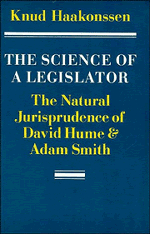
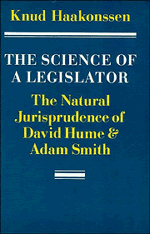
Combining the methods of the modern philosopher with those of the historian of ideas Knud Haakonssen presents an interpretation of the philosophy of law which Adam Smith developed out of -- and partly in response to -- David Hume's theory of justice. While acknowledging that the influences on Smith were many and various Dr Haakonssen suggests that the decisive philosophical one was Hume's analysis of justice in A Treatise of Human Nature and the second Enquiry. He therefore begins with a thorough investigation of Hume from which he goes on to show the philosophical originality of Smith's new form of natural jurisprudence. At the same time he provides an over-all reading of Smith's social and political thought demonstrating clearly the exact links between the moral theory of The Theory of Moral Sentiments the Lectures on Jurisprudence and the socio-historical theory of The Wealth of Nations.<P>This is the first full analysis of Adam Smith's jurisprudence; it emphasizes its normative and critical function and relates this to the psychological sociological and historical aspects which hitherto have attracted most attention. Dr Haakonssen is critical of both purely descriptivist and utilitarian interpretations of Smith's moral and political philosophy and demonstrates the implausibility of regarding Smith's view of history as pseudo-economic or 'materialist'. By drawing on all of Smith's works he shows that the framework for Smith's discussion is an interesting theory of human knowledge which leads to an original philosophy of history.<P>The book will interest scholars and students of moral political and legal philosophy and their histories eighteenth-century history andthe history of ideas.

Piracy-free

Assured Quality

Secure Transactions

Fast Delivery

Sustainably Printed
Details
ISBN 13
9780521376259
Publication Date
-09-07-1989
Pages
-252
Weight
-346 grams
Dimensions
-152x229x14.51 mm
