

English


Hardback
₹11722
(All inclusive*)
Delivery Options
Please enter pincode to check delivery time.
*COD & Shipping Charges may apply on certain items.
Review final details at checkout.
Looking to place a bulk order? SUBMIT DETAILS
Delivery Options
Please enter pincode to check delivery time.
*COD & Shipping Charges may apply on certain items.
Review final details at checkout.
About The Book
Description
Author
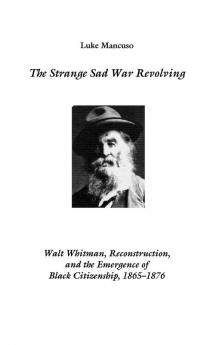
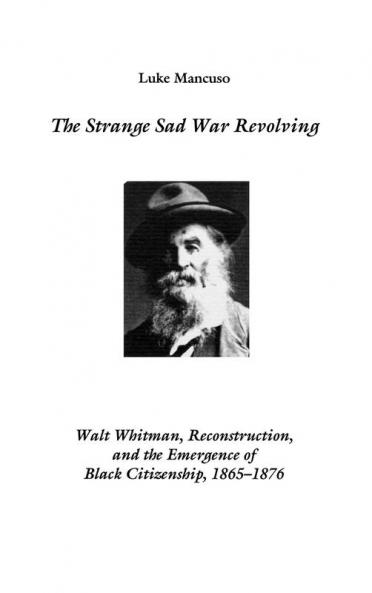
Walt Whitman's prolific Reconstruction project has remained the most uncultivated decade in Whitman studies for over a century. This first book-length analysis points the way for a needed recovery of Whitman's 1865-1876 publications by considering them in the context of the legislative discourse of black emancipation and its stormy aftermath. While Whitman's Union ideology is virtually uncontested the perceived absence of attention to race relations in his postwar texts has recently become a source of curiosity and a target of criticism. From 1865 to 1876 the Congressional workshop was seeking to forge interracial civil rights legislation. Congress's increasingly coercive surveillance of the implementation of such egalitarianism was manifested in the Civil War Amendments the Enforcement Acts of 1870-1871 and the Civil Rights Act of 1875. Throughout this unsettled period the Radical Republican agitation for civil rights on behalf of black Americans found unmistakable echoes in Whitman's textual images of the postwar Union. By yoking together literary and legislative discourses this book provides a rhetorical pathway for the recovery of the emancipatory significance of Whitman's works of the Reconstruction decade. As a largely unacknowledged legislator in his day Whitman had always demanded Radical Democracy as his central model for social solidarity. However after the Civil War the public presence of blacks had forced Congress to reckon publicly with the issue of black civil rights in the face of racism and sectionalism. By welcoming ex-slaves into the Union Whitman's Reconstruction texts enlisted his representations in the federalizing rhetoric of civil rights protection that would lapse for almost a century before being taken up again in the Second Reconstruction of the 1950s and 1960s. LUKE MANCUSO is associate professor of English at St. John's University in Collegeville Minnesota.

Piracy-free

Assured Quality

Secure Transactions

Fast Delivery

Sustainably Printed
Details
ISBN 13
9781571131256
Publication Date
-01-09-1997
Pages
-170
Weight
-327 grams
Dimensions
-152x229x14.29 mm
