








Paperback
₹895
(All inclusive*)
Delivery Options
Please enter pincode to check delivery time.
*COD & Shipping Charges may apply on certain items.
Review final details at checkout.
Looking to place a bulk order? SUBMIT DETAILS
Delivery Options
Please enter pincode to check delivery time.
*COD & Shipping Charges may apply on certain items.
Review final details at checkout.
About The Book
Description
Author
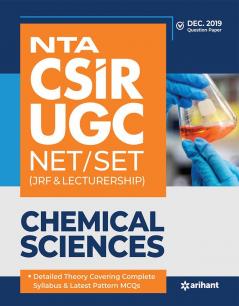
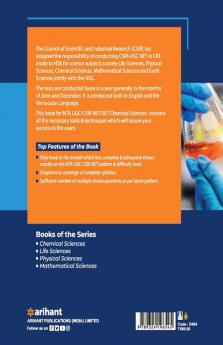
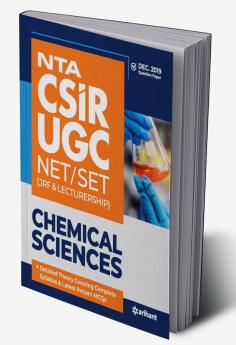
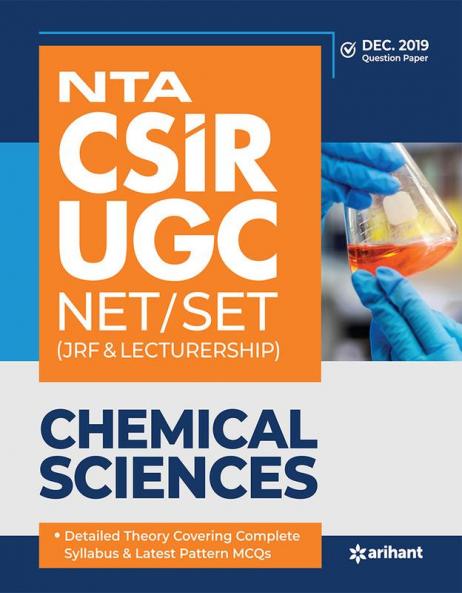
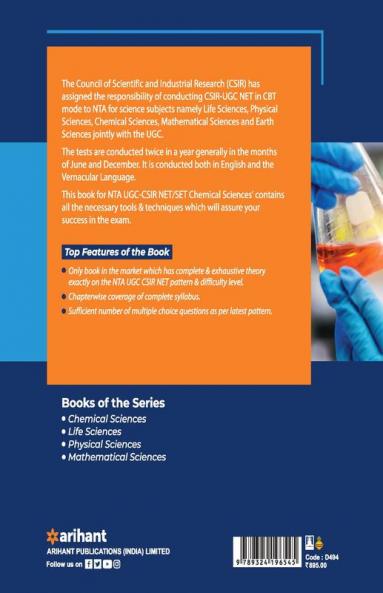
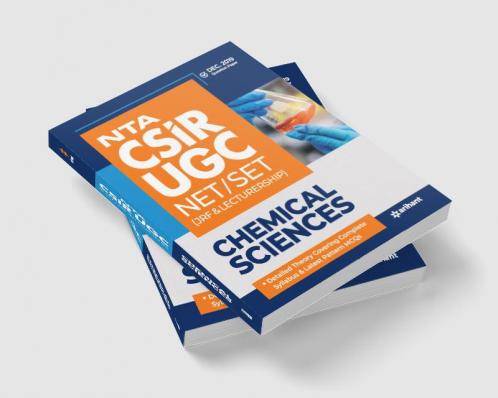
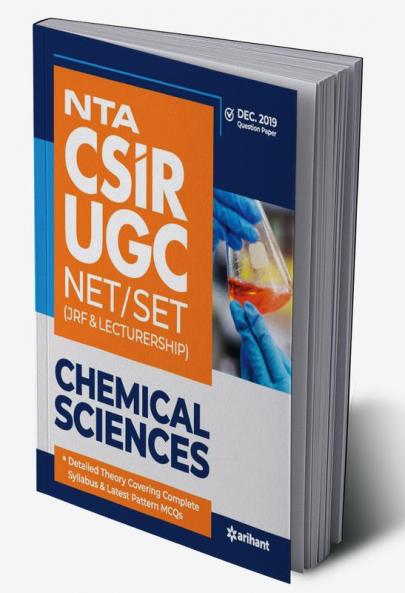
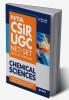
A Great teacher is required to be a great learner with ability to synthesize and integrateknowledge. The Council of Scientific and Industrial Research (CSIR) has entrusted theresponsibility of conducting CSIR-UGC NET in CBT Mode to NTA. CSIR – UGC is a nationallevel test conducted twice a year (June & December) to determine the eligibility for JuniorResearch Fellowship (JRF) and for Lectureship (LS)/ Assistant Professorship’ in IndianUniversities and Colleges. UGC CSIR NET/SET (JRF & LS) Chemical Sciences is a well formulated combination of easylearning techniques and practice problems containing all the necessary tools and techniqueswhich assure your success. The entire syllabus of this revised edition has been divided under39 Chapters giving a complete Chapterwise theory of syllabus accommodated with all therecent changes. In addition to the theoretical portion the book also concentrates on the practicalpart by providing Previous Years’ Solved Papers which are designed according to the patternsuggested by the council. Questions provided in the book for practice give an idea of the levelexaminations that have been conducted and moreover they help to track the level of preparationis done by the candidates. Packed with Detailed theory and Latest Pattern MCQs for the pagethis book makes a systematic ladder to success in CSIR – UGC NET/SET.TABLE OF CONTENTChemical Periodicity and Chemistry of Main Group Elements Chemical Bonding and Structureof Molecules Acid-Base Chemistry s-Block Elements p-Block Elements-I The p-BlockElements-II Noble Gases d-Block Elements or Transition Elements Coordination ChemistryInner Transition Elements Organ metallic Compounds Analytical Chemistry BioinorganicChemistry Coordination Compounds - II Nuclear Chemistry Quantum Mechanics or WaveMechanics Atomic Structure and Quantum Theory Chemical Bonding and DiatomicsMolecular Symmetry and Group Theory Molecular Spectroscopy Thermodynamics StatisticalThermodynamics Electrochemistry Chemical Kinetics Surface Chemistry Solid State IUPACNomenclature of Organic Compounds IUPAC Nomenclature of Organic CompoundsStereochemistry Aromaticity Organic Reaction Mechanism and Reactive IntermediatesCommon Named Reactions and Rearrangements Organic Transformations and ReagentsConcept in Organic Synthesis and Asymmetric Synthesis Pericyclic Reactions PhotochemistryHeterocyclic Compounds Chemistry of Natural Products Interdisciplinary Topics SampleQuestions Provided on CSIR website Solved Paper 2016-19].

Piracy-free

Assured Quality

Secure Transactions

Fast Delivery

Sustainably Printed
Details
ISBN 13
9789324196545
Publication Date
-22-02-2020
Pages
-1456
Weight
-2263 grams
Dimensions
-203.2x260.35x56.76 mm
