

English


₹3834
₹4423
13.32% OFF
(All inclusive*)
Hardback
Delivery Options
Please enter pincode to check delivery time.
*COD & Shipping Charges may apply on certain items.
Review final details at checkout.
Looking to place a bulk order? SUBMIT DETAILS
Delivery Options
Please enter pincode to check delivery time.
*COD & Shipping Charges may apply on certain items.
Review final details at checkout.
About The Book
Description
Author
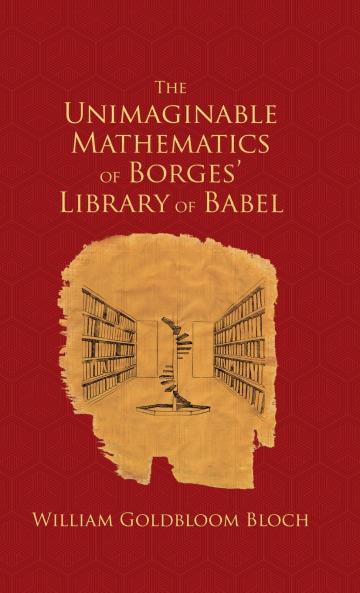
The Library of Babel is arguably Jorge Luis Borges' best known story--memorialized along with Borges on an Argentine postage stamp. Now in <em>The Unimaginable Mathematics of Borges' Library of Babel</em> William Goldbloom Bloch takes readers on a fascinating tour of the mathematical ideas hidden within one of the classic works of modern literature. <p/> Written in the vein of Douglas R. Hofstadter's Pulitzer Prize-winning <em>G&#65533;del Escher Bach</em> this original and imaginative book sheds light on one of Borges' most complex richly layered works. Bloch begins each chapter with a mathematical idea--combinatorics topology geometry information theory--followed by examples and illustrations that put flesh on the theoretical bones. In this way he provides many fascinating insights into <em>Borges' Library</em>. He explains for instance a straightforward way to calculate how many books are in the Library--an easily notated but literally unimaginable number--and also shows that if each book were the size of a grain of sand the entire universe could only hold a fraction of the books in the Library. Indeed if each book were the size of a proton our universe would still not be big enough to hold anywhere near all the books. <p/> Given Borges' well-known affection for mathematics this exploration of the story through the eyes of a humanistic mathematician makes a unique and important contribution to the body of Borgesian criticism. Bloch not only illuminates one of the great short stories of modern literature but also exposes the reader--including those more inclined to the literary world--to many intriguing and entrancing mathematical ideas.<br>

Piracy-free

Assured Quality

Secure Transactions

Fast Delivery

Sustainably Printed
Details
ISBN 13
9780195334579
Publication Date
-01-09-2008
Pages
-214
Weight
-334 grams
Dimensions
-140x216x12.7 mm
