


This Book is Out of Stock!
English


₹2583
(All inclusive*)
Paperback
Delivery Options
*COD & Shipping Charges may apply on certain items.
Review final details at checkout.
Looking to place a bulk order? SUBMIT DETAILS
*COD & Shipping Charges may apply on certain items.
Review final details at checkout.
₹2583
Out Of Stock
All inclusive*
About The Book
Description
Author
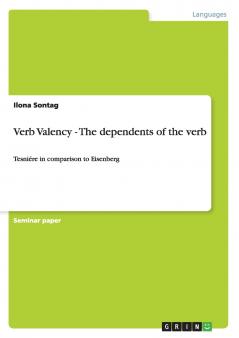
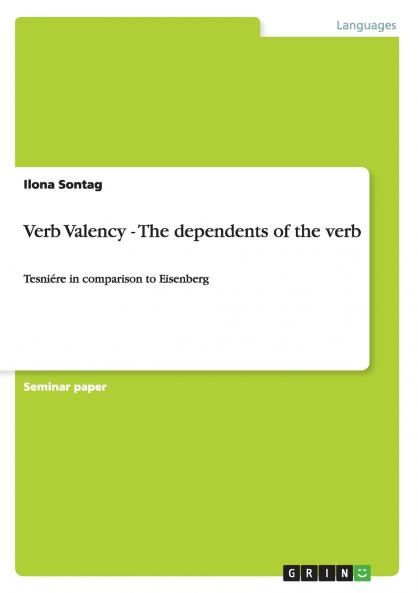
Seminar paper from the year 2008 in the subject Didactics for the subject English - Grammar Style Working Technique grade: 17 RWTH Aachen University (Institut für Anglistik ) course: Syntactic Questions language: English abstract: Although the idea of valency is not new in the field of linguistics it seems to have receivedrelatively little attention up to now. Lucien Tesnière who became known as the developer ofthe so called dependency grammar was one of the first linguists who described thecapacity of a verb to bind a certain number of actants1 (cf. Tesnière 1980 385-386). In hisposthumously published book Eléments de syntaxe structurale2 (1959) he called thisphenomenon valency. Later on other linguists adopted his notion modified and adapted it.One of these linguists is Peter Eisenberg a German philologist who wrote some recentworks on grammar in which the role of verb valency is often in the center of attention.Because a period of thirty years had passed since Tesnière's first attempt to define thephenomenon of valency in linguistics Eisenberg's approach is a lot more detailed andincludes different criteria for he had the opportunity to contribute his knowledge of othertheories which were created after Tesnière's book had been published.This term paper will draw a comparison of two works written by the authors mentionedabove with special regard to the words which are dependent on verbs. Since the verb is oftenin the center of attention when the notion of valency is concerned the group of the otherwords which are governed by the verb does not seem to be examined in the same way.Furthermore there does not even seem to be a standard term for such words (perhaps exceptfor arguments (cf. Meyer 2005 30) but even the notion of arguments is used in diverseways) so that I will use the word dependents to refer to every possible linguistic elementwhich can be bound by a verb.The main aim of this pape

Piracy-free

Assured Quality

Secure Transactions

Fast Delivery

Sustainably Printed
Details
ISBN 13
9783640194315
Publication Date
-24-10-2008
Pages
-20
Weight
-39 grams
Dimensions
-148x210x1.22 mm
