


English


₹8850
₹9249
4.31% OFF
(All inclusive*)
Hardback
Delivery Options
Please enter pincode to check delivery time.
*COD & Shipping Charges may apply on certain items.
Review final details at checkout.
Looking to place a bulk order? SUBMIT DETAILS
Delivery Options
Please enter pincode to check delivery time.
*COD & Shipping Charges may apply on certain items.
Review final details at checkout.
About The Book
Description
Author(s)
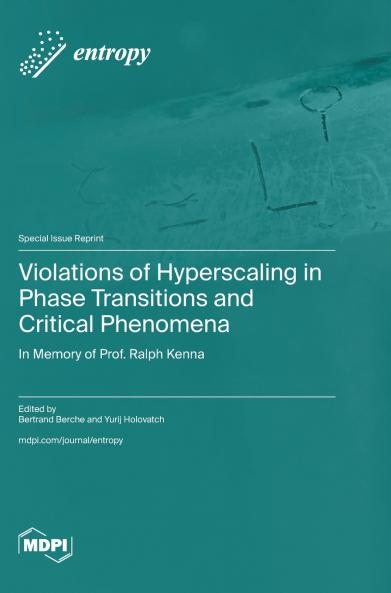
<p>This Special Issue was initiated by Prof. Ralph Kenna (August 27 1964-October 26 2023) who at the time was a member of the <em>Entropy</em> Editorial Board and it is dedicated to his memory. Universality is a striking feature of critical phenomena and its origin is largely illuminated by the renormalization group. Universality allows for the essential aspects of critical behaviour in complex physical systems to be captured through highly simplified models where only key components such as spatial dimensionality symmetry and interaction range are retained. Both theoretical models and real systems are thus grouped into universality classes which are characterised by sets of critical exponents connected through scaling relations. When these relations explicitly involve dimensionality they are referred to as hyperscaling.&nbsp;In many systems with a high degree of connectivity mean-field theory provides accurate predictions independently of spatial dimension leading to the common assertion that hyperscaling breaks down in such cases. However this conventional view has been reconsidered in light of recent renormalization group developments which suggest mechanisms by which hyperscaling might be preserved in an extended version even above the upper critical dimension. The contributions collected in this reprint address these issues focusing on scaling properties beyond the upper critical dimensionality as well as related challenges in the broader theory of phase transitions and critical phenomena.</p>

Piracy-free

Assured Quality

Secure Transactions

Fast Delivery

Sustainably Printed
Details
ISBN 13
9783725851478
Publication Date
-24-09-2025
Pages
-266
Weight
-539 grams
Dimensions
-170x244x22.23 mm
