


This Book is Out of Stock!
English


Paperback
₹5758
₹6400
10.02% OFF
(All inclusive*)
Delivery Options
*COD & Shipping Charges may apply on certain items.
Review final details at checkout.
Looking to place a bulk order? SUBMIT DETAILS
*COD & Shipping Charges may apply on certain items.
Review final details at checkout.
₹5758
₹6400
10% OFF
Paperback
Out Of Stock
All inclusive*
About The Book
Description
Author(s)
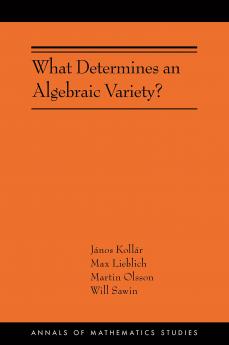
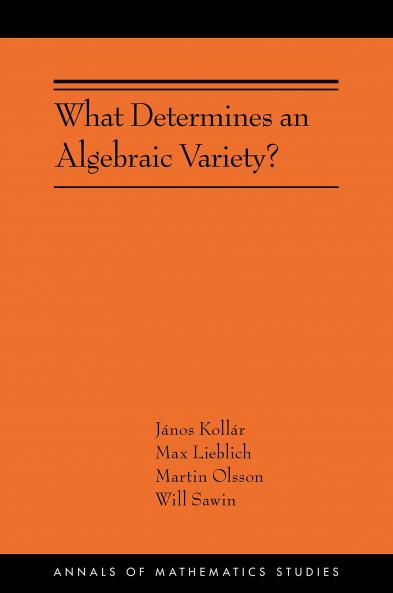
<p><b>A pioneering new nonlinear approach to a fundamental question in algebraic geometry</b> <p/>One of the crowning achievements of nineteenth-century mathematics was the proof that the geometry of lines in space uniquely determines the Cartesian coordinates up to a linear ambiguity. <i>What Determines an Algebraic Variety? </i>develops a nonlinear version of this theory offering the first nonlinear generalization of the seminal work of Veblen and Young in a century. While the book uses cutting-edge techniques the statements of its theorems would have been understandable a century ago; despite this the results are totally unexpected. Putting geometry first in algebraic geometry the book provides a new perspective on a classical theorem of fundamental importance to a wide range of fields in mathematics. <p/>Starting with basic observations the book shows how to read off various properties of a variety from its geometry. The results get stronger as the dimension increases. The main result then says that a normal projective variety of dimension at least 4 over a field of characteristic 0 is completely determined by its Zariski topological space. There are many open questions in dimensions 2 and 3 and in positive characteristic.</p>

Piracy-free

Assured Quality

Secure Transactions

Fast Delivery

Sustainably Printed
Details
ISBN 13
9780691246819
Publication Date
-25-07-2023
Pages
-240
Weight
-386 grams
Dimensions
-156x235x14.64 mm
