

English


₹5457
(All inclusive*)
Paperback
Delivery Options
Please enter pincode to check delivery time.
*COD & Shipping Charges may apply on certain items.
Review final details at checkout.
Looking to place a bulk order? SUBMIT DETAILS
Delivery Options
Please enter pincode to check delivery time.
*COD & Shipping Charges may apply on certain items.
Review final details at checkout.
About The Book
Description
Author
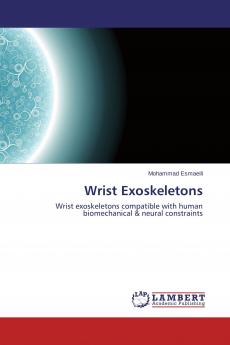
Daily motor tasks are often redundant. Humans are known to adopt motor strategies which consist of a stereotypical selection of specific postures for a given task. Such natural strategies are also known to be perturbed. An exoskeleton specifically designed to minimally perturb motor strategies was used to study the effects of ergonomic factors and mechanical impedance on human motor strategies during redundant tasks. Special attention is devoted to wrist robots since the human wrist together with the hand is involved in most manipulation tasks. To comply with kinematic constraints ergonomic considerations are introduced at an early stage of design of exoskeleton matching the biomechanical constraints imposed by human anatomy. Due to inter-subject anatomical differences subject-specific kinematic models are determined to be used in the design of exoskeletons. The effects of kinematic compatibility on motor strategies are assessed and solutions from literature are adopted to avoid over-constrained configurations. Finally a low-inertia wrist exoskeleton is devised and tested to be compatible with both biomechanical and neural constraints during pointing tasks.

Piracy-free

Assured Quality

Secure Transactions

Fast Delivery

Sustainably Printed
Details
ISBN 13
9783659415838
Publication Date
-05-03-2015
Pages
-192
Weight
-268 grams
Dimensions
-150x220x10.46 mm
